London Dispatch / May 2026 / Part I
Four galleries take a cue from London Craft Week.
Gallery FUMI
‘By Which We Live’
30th April – 20th June 2026
Erskine, Hall & Coe.
‘Genta Ishizuka: absence, presence’
1st – 23rd May 2026
David Gill Gallery
‘Barnaby Barford: We Are Where We Are’
1st – 30th May 2026
Lisson Gallery
Ken Price
1st May – 25th July 2026
By TDE Editorial Team / 8th May 2026
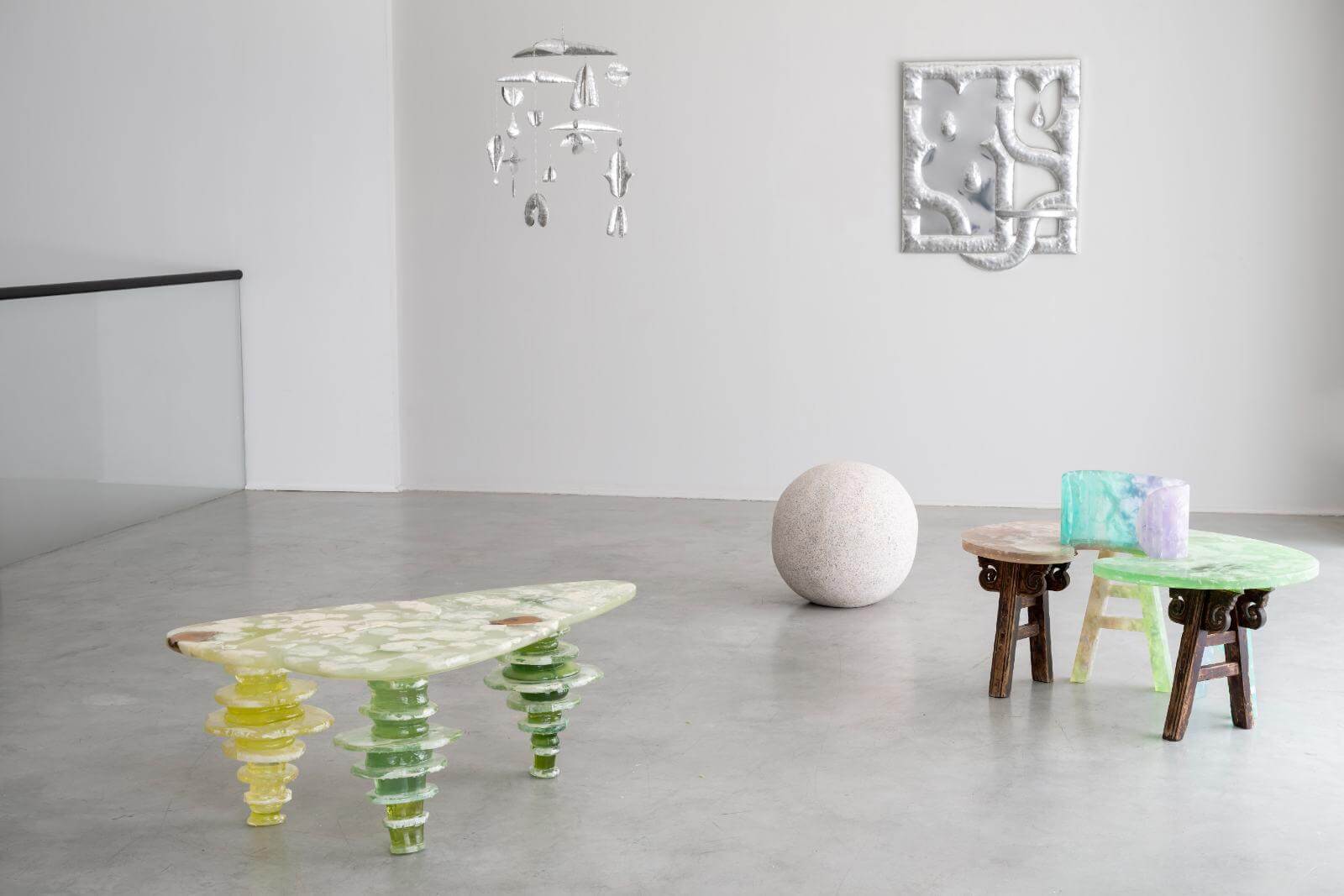
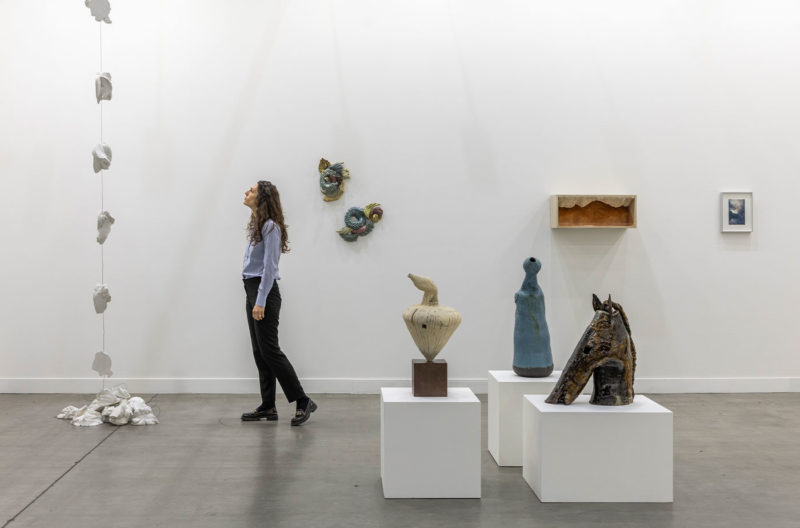
Exhibition view, ‘By Which We Live’
COURTESY: Gallery FUMI / PHOTOGRAPH: Penguins Egg Studio
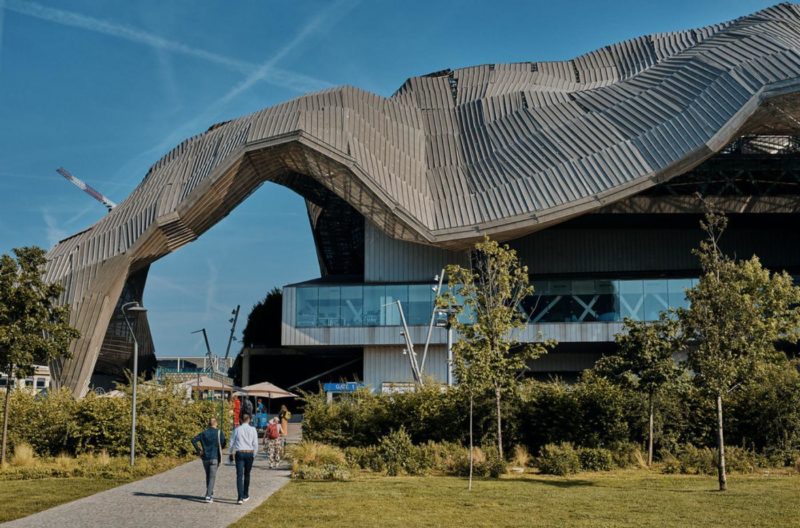
THIS WEEK, LONDON Craft Week has unfurled through the capital, featuring auction sales, pop-up exhibitions, workshops, talks, demonstrations and symposia. Anchored this year by Sotheby’s ‘Crafted’ programme (based in its London Bond Street headquarters), the festival, first launched twelve years ago, has embraced a whole sweep of institutions – from fine art galleries to luxury fashion houses, City guilds to design galleries.
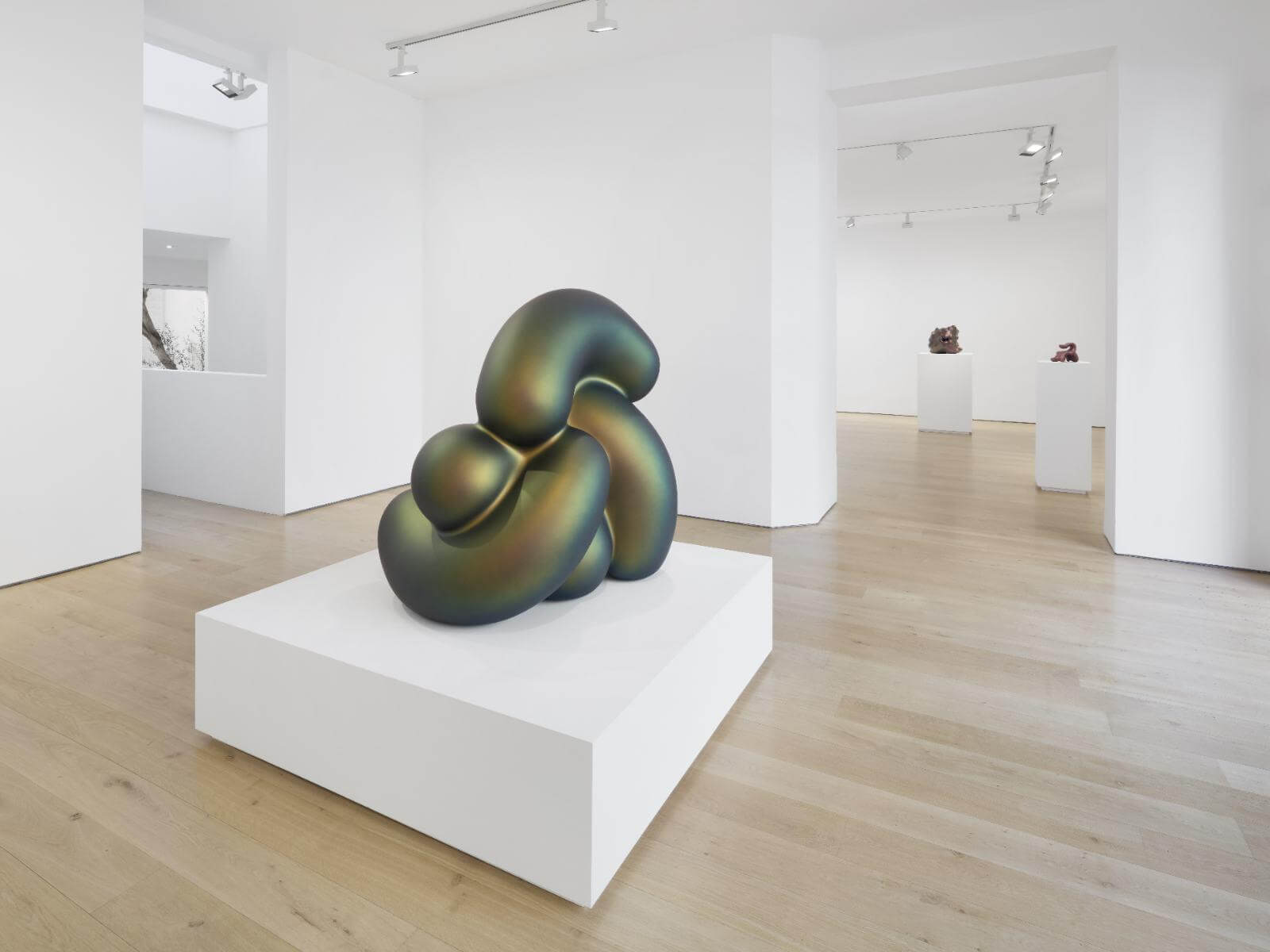
Exhibition view, ‘Ken Price’ with ‘Ceejay’, 2011
COURTESY: Ken Price & Lisson Gallery
As in Europe, interest in craft – in traditional hand processes and organic materials, in one-off or limited edition production, where time and rarity are as significant constituents of the value of objects as skill and imagination – seems to grow unbated.
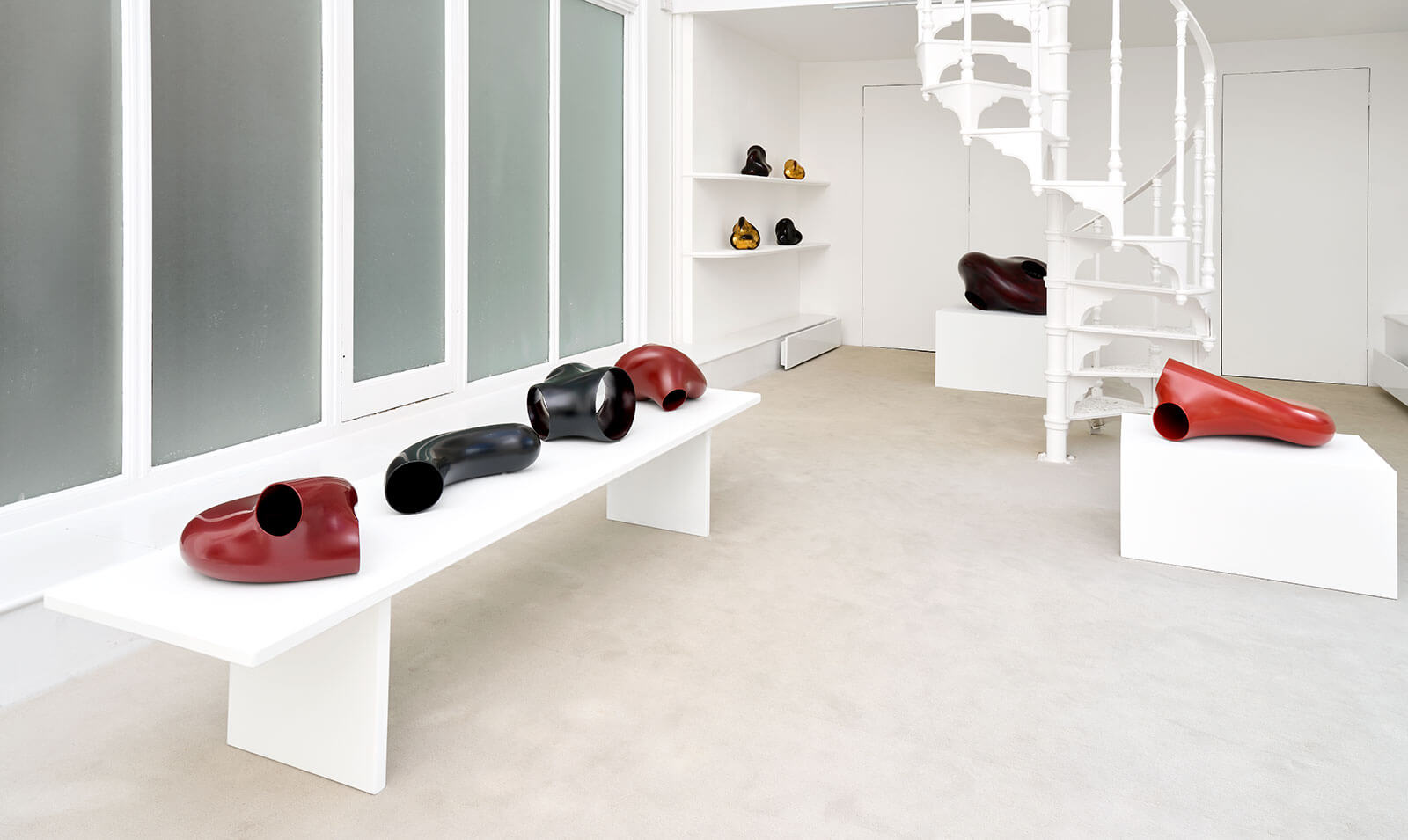
Exhibition view ‘Genta Ishizuka: absence, presence’
COURTESY: Genta Ishizuka & Erskine, Hall & Coe / PHOTOGRAPH: Stuart Burford
At this high point for design and craft in London in early May, a slew of gallery exhibitions have opened focusing on masters of materials and processes. In this first Dispatch, we will cover four of the best.
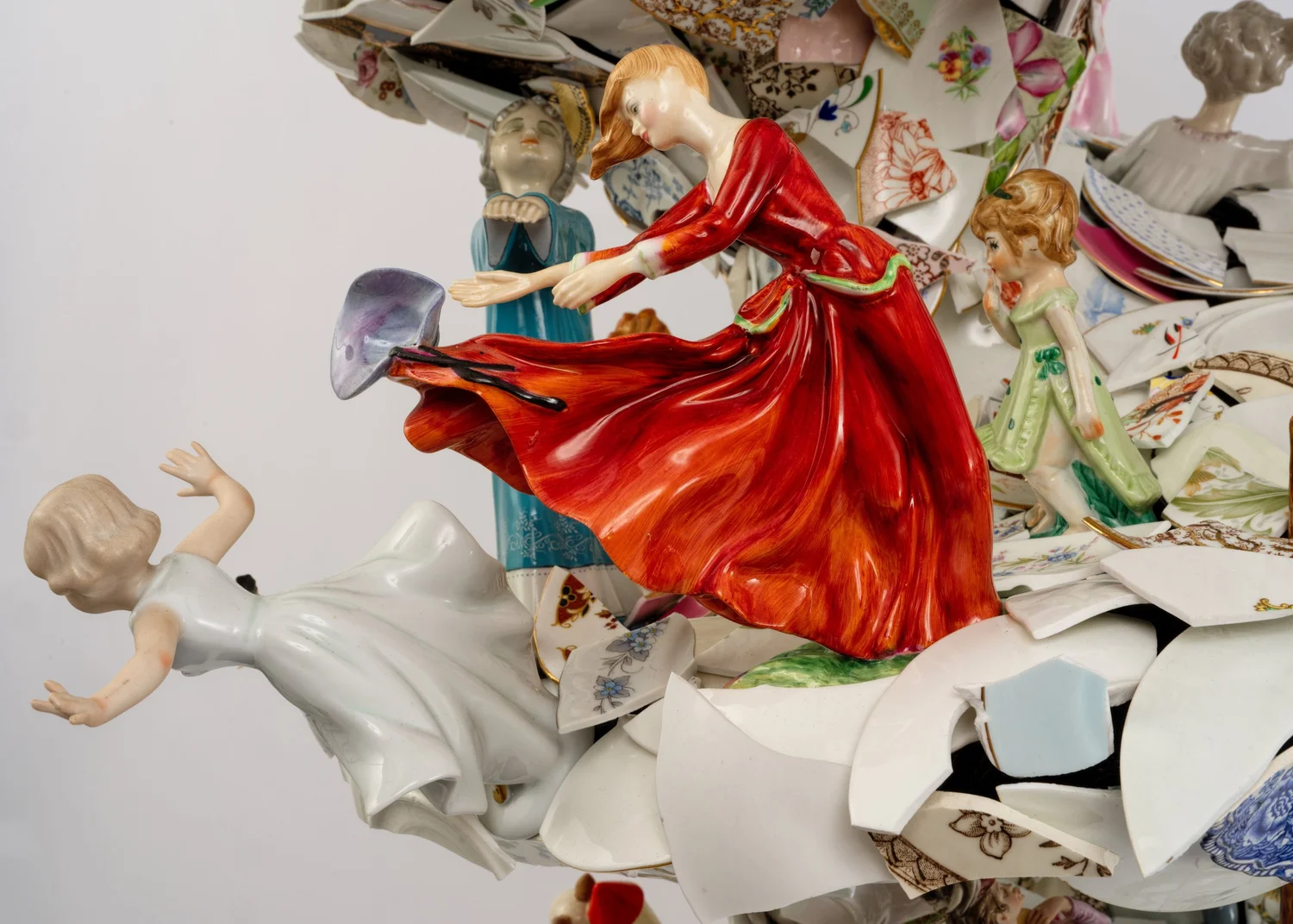
Barnaby Barford, ‘Scream to go FASTER’, 2026 (detail)
COURTESY: Barnaby Barford & David Gill Gallery / PHOTOGRAPH: Sylvain Deleu
‘By Which We Live’
Gallery FUMI
Until 20th June
For this early summer show, Fumi has invited all its female artists and designers to respond to a single question: “How does your work express you: the way you live, the way you think, the way you respond to the world?”
As you enter, a large folding screen – a cutout of a woman with a long dark waterfall of hair, sitting holding her rosy knees – dominates. Created by Saelia Aparicio, this female figure presides over a company of women portrayed in her plywood stools. Here, female emotions and female bodies carve out space in these quintessentially cubic forms for their own expressive purposes, both protective and vulnerable. The audience cannot ignore them.
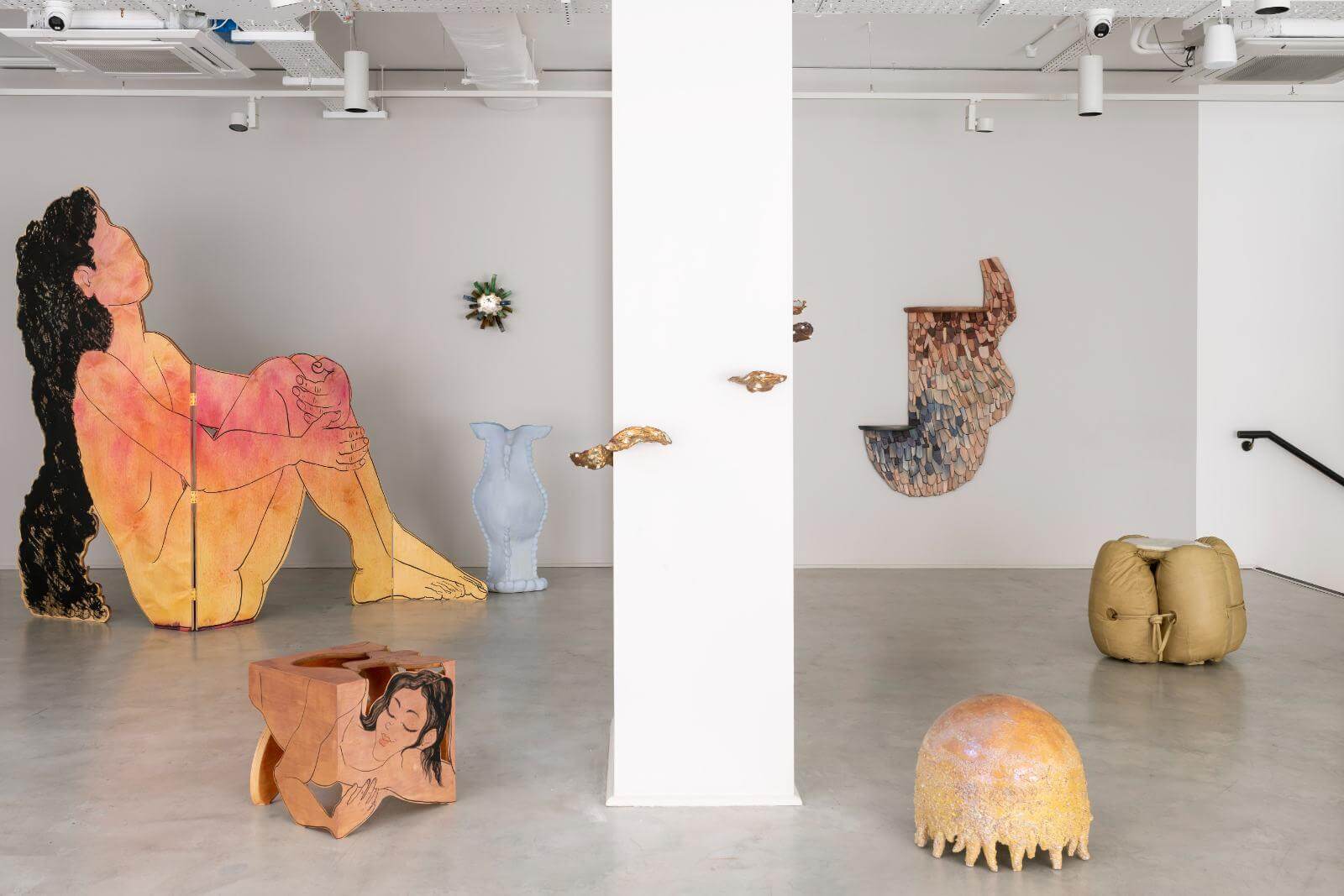
Exhibition view, ‘By Which We Live’
COURTESY: Gallery FUMI / PHOTOGRAPH: Penguins Egg Studio
In response to FUMI’s challenge, some designers have made new work. Emma Witter has made a new iteration of her ‘Ocean Mirror’ series, using materials she has salvaged – mudlarked metals, an antique mirror, and British rock oyster shells saved from restaurants – to create a playful rococo wall-piece, commenting, “For me, craft is not simply a method of production but a way of being in the world, a means of connecting with material, time and systems of value.”
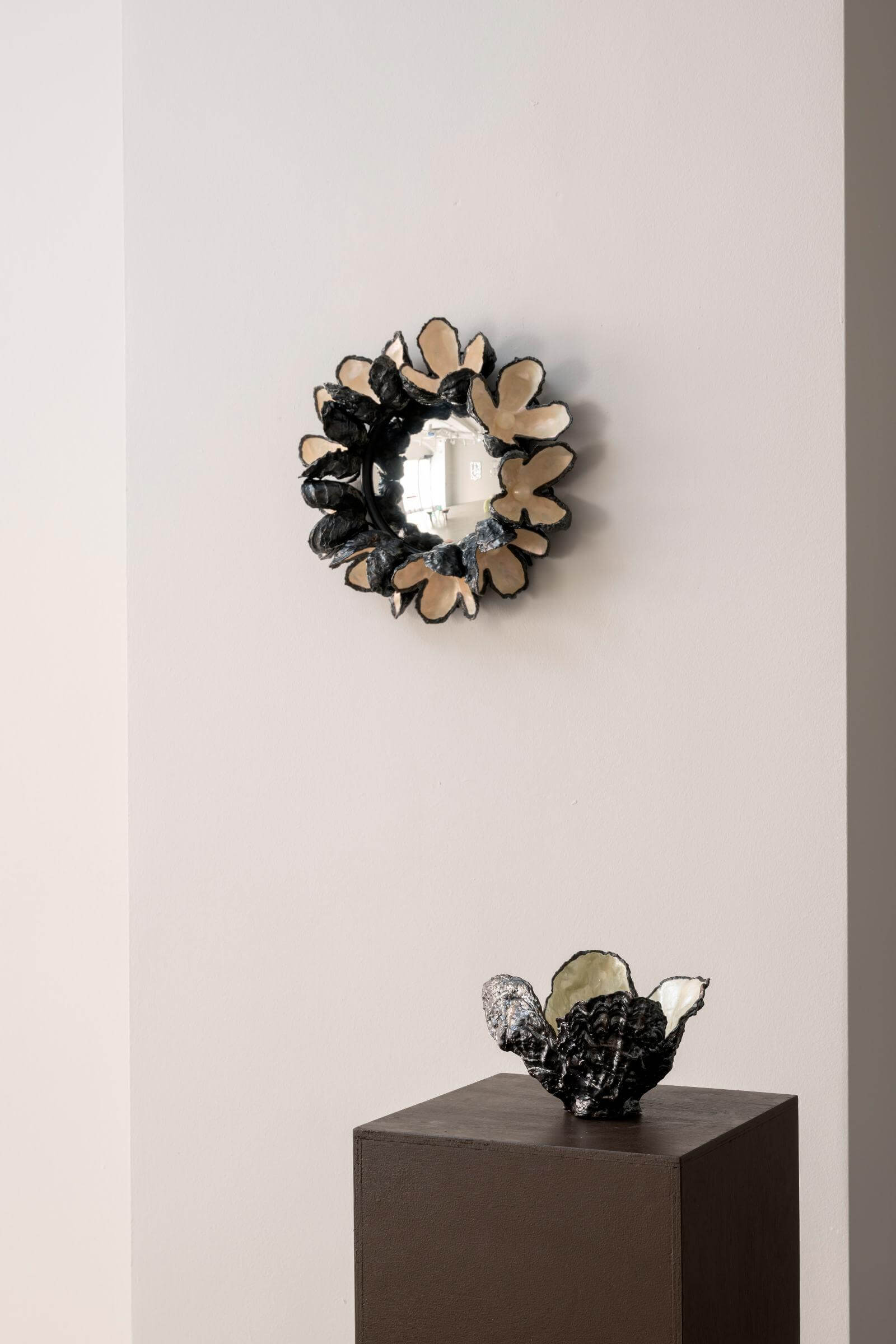
Exhibition view, ‘By Which We Live’ with: Emma Witter, ‘Ocean Mirror X’, 2026
COURTESY: Gallery FUMI / PHOTOGRAPH: Penguins Egg Studio
Others have selected earlier pieces which best epitomise the ideas and practices “by which we live”. Printed on the wall above her elegant resin and antique wood composite bench ‘Dialogues’, is a statement by Chinese-born designer Jie Wu, “I’ve come to see making as a way of thinking – staying with something long enough for it to reveal itself.” A new designer for the gallery, Bregje Sliepenbeek, from Amsterdam, explains that metamorphosis of materials is what drives her silversmithing practice, “the magic of transforming a cold, hard material into something that feels soft and organic.” Her sculptural wall piece is both reflective and tactile, almost cushiony.
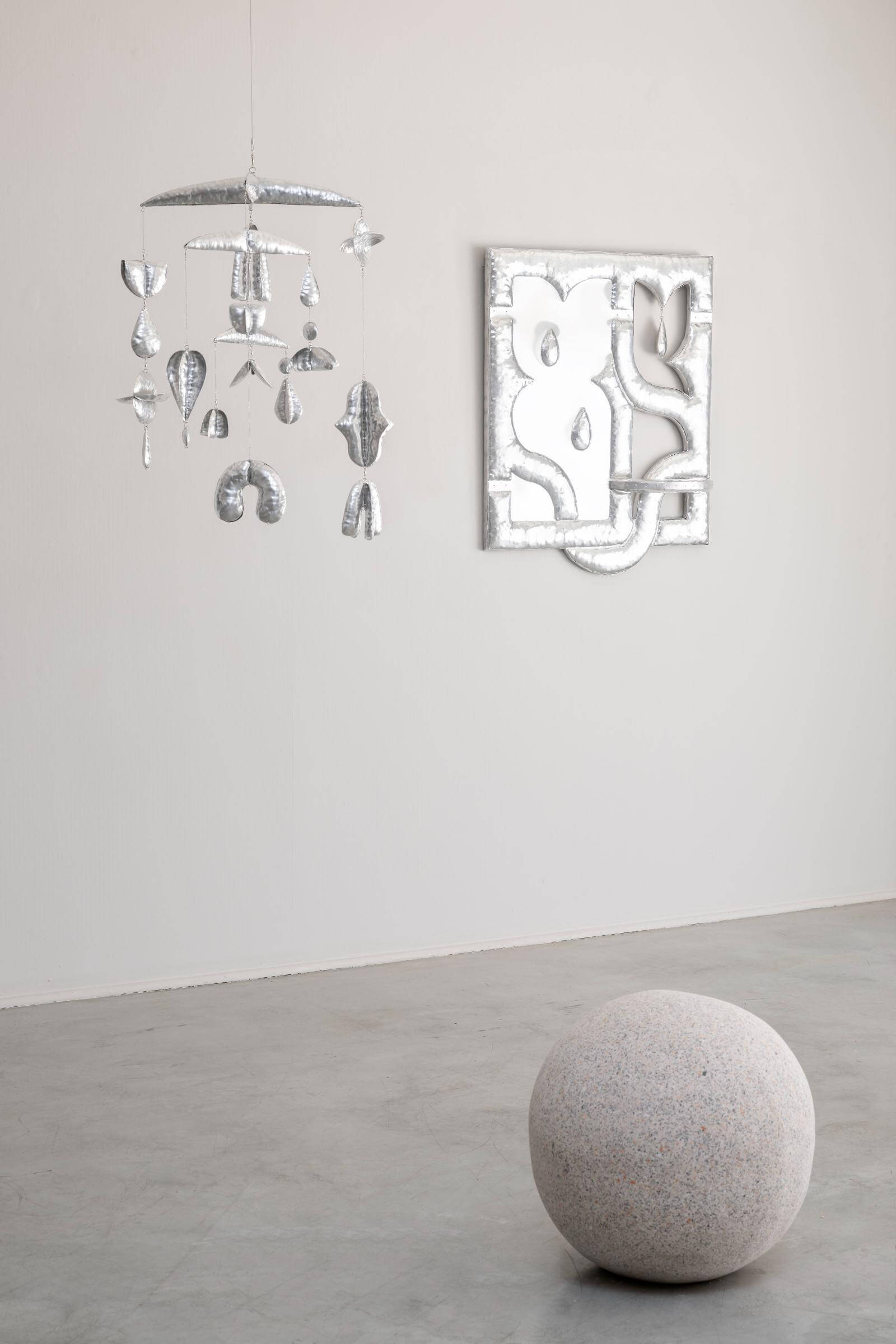
Exhibition view, ‘By Which We Live’ with (left to right): Bregje Sliepenbeek, ‘Wallpiece’, 2026; Bregje Sliepenbeek, ‘Mobile’, 2026; Study O Portable, ‘Rubber Rocks Sphere’, 2026
COURTESY: Gallery FUMI / PHOTOGRAPH: Penguins Egg Studio
For some, this is an opportunity for the female half of a design duo – Sarah van Gameren (of Glithero), Corinna Dehn (who works with partner Lukas Wegwerth) and Bernadette Deddens (of Study O Portable) – to present work that reflects their own particular creative temperament. Van Gameren, for instance, presents a Glithero ‘Bench Mould Rail’ console with a red top – never put into production until now. Dehn’s wall-mounted piece with two shelves created from wooden shingles (in the style of Wegwerth’s ‘Armadillo’ series) reflects the more contemplative side of her character that has emerged in early motherhood. It has been an interesting experiment. The delicacy of her new observations of nature and her baby are reflected in the soft, shifting colours of the shingles and the gently curved shape of the piece. Without representing a cliche of femininity, the show makes a convincing presentation of distinctively female creativity.
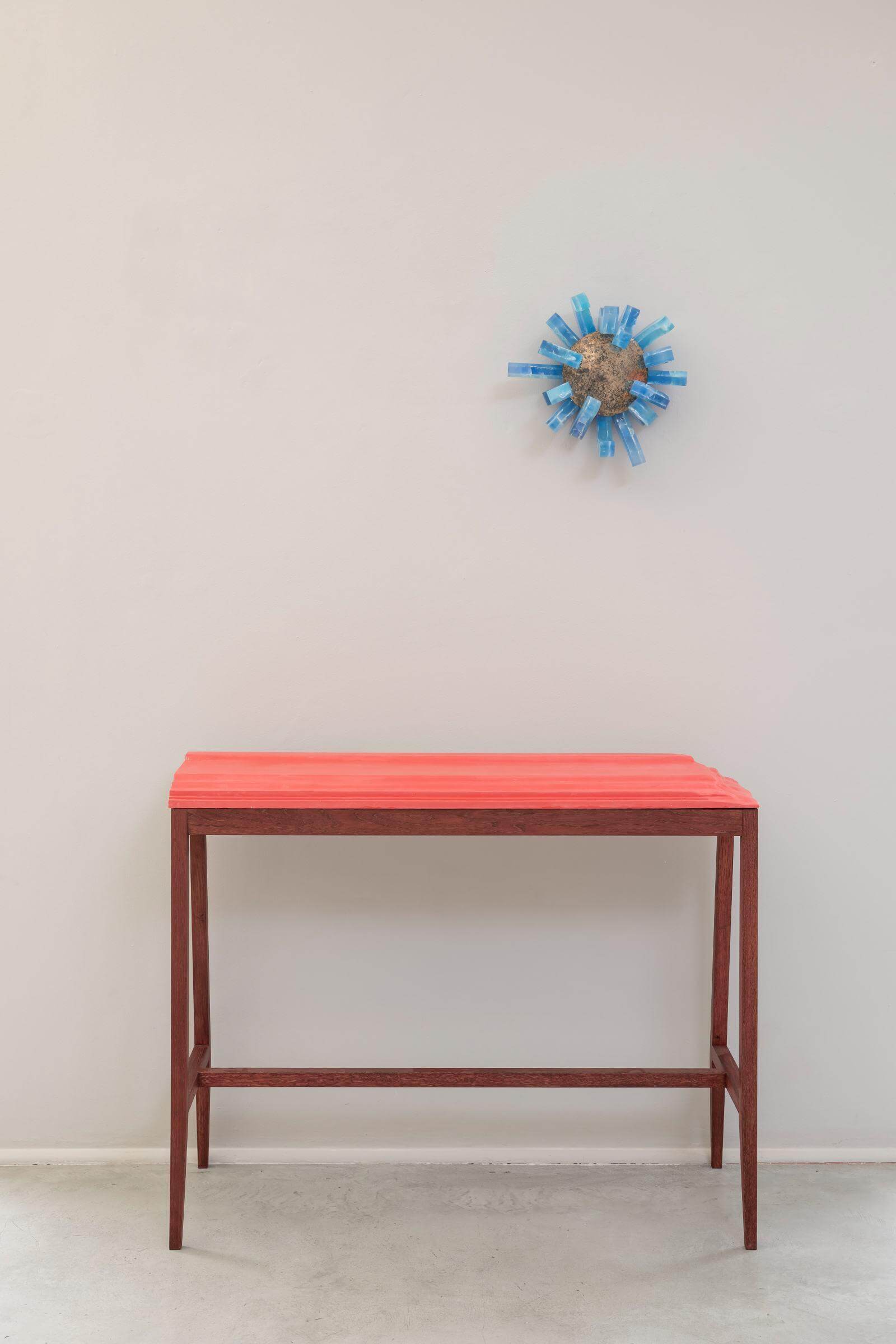
Exhibition view, ‘By Which We Live’ with: Glithero, ‘Bench Mould Rail Console’, 2026; Jie Wu, ‘Blooming No. 3’, 2024
COURTESY: Gallery FUMI / PHOTOGRAPH: Penguins Egg Studio
‘Genta Ishizuka: absence, presence’
Erskine, Hall & Coe
Until 23rd May
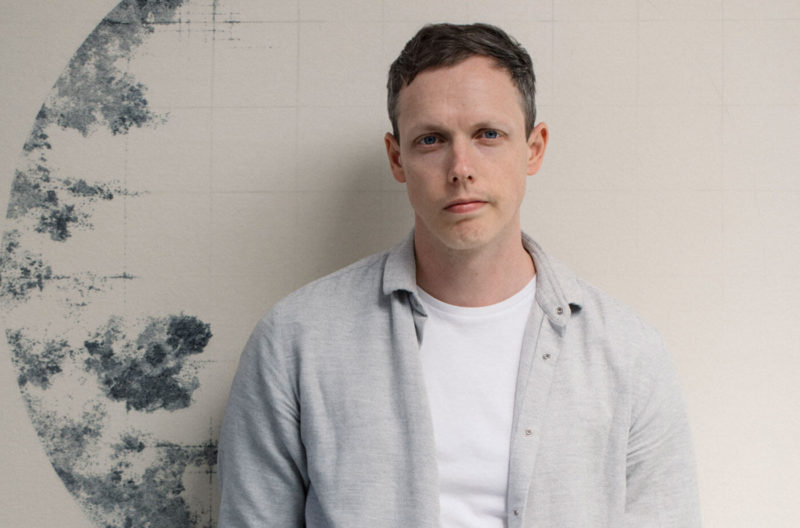
In 2019, Genta Ishizuka won the Loewe Foundation’s prestigious Craft Prize. Today, he is renowned as a master of contemporary lacquer. A piece from his 2024 series ‘Taxis Groove’ features in the V&A’s recently opened display ‘Urushi Now: Contemporary Japanese Lacquer’, but he also has work in the British Museum, the Ashmolean in Oxford, The National Museum of Modern Art in Kyoto and other major international institutions.
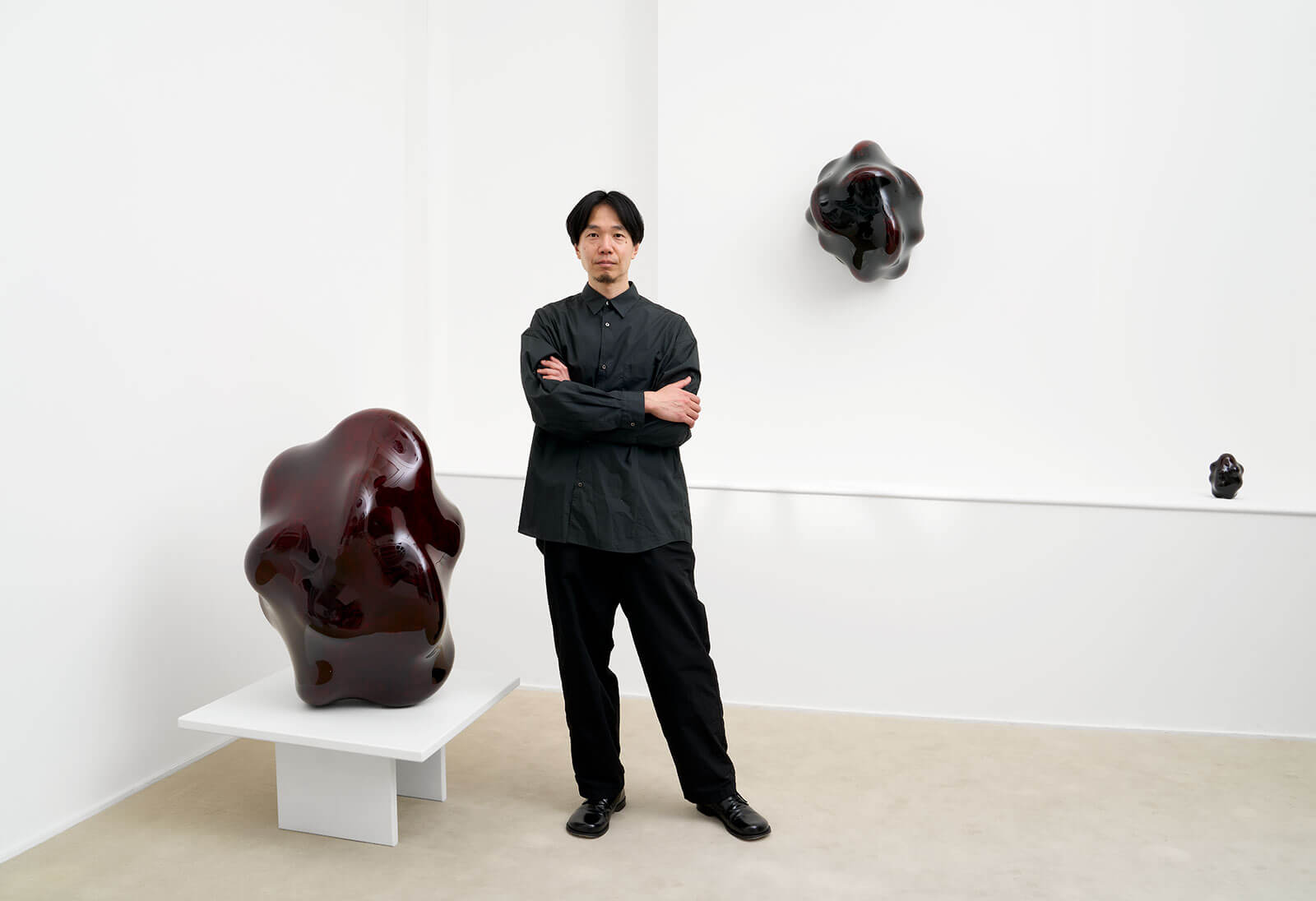
Genta Ishizuka at his exhibition ‘absence, presence’
COURTESY: Genta Ishizuka & Erskine, Hall & Coe / PHOTOGRAPH: Stuart Burford
This is his third solo show at Erskine, Hall & Coe. Ishizuka is renowned for his unique practice, using industrial tubes or other spherical objects to create his organic forms, which he then wraps in stretchable fabric. Using the traditional Japanese technique of Kanshitsu, Ishizuka then applies layers of hemp cloth and urushi, the natural sap of the urushinoki tree, until the structure is stable, when the original support can be removed and the opening sealed. Critical to the whole process is the polishing that occurs between each application of lacquer, deepening the colour and creating a lustrous sheen. As Ishizuka puts it, “This sheen is central to how the materiality and temporality of urushi becomes visible.” It is this that gives his forms their vibrancy.
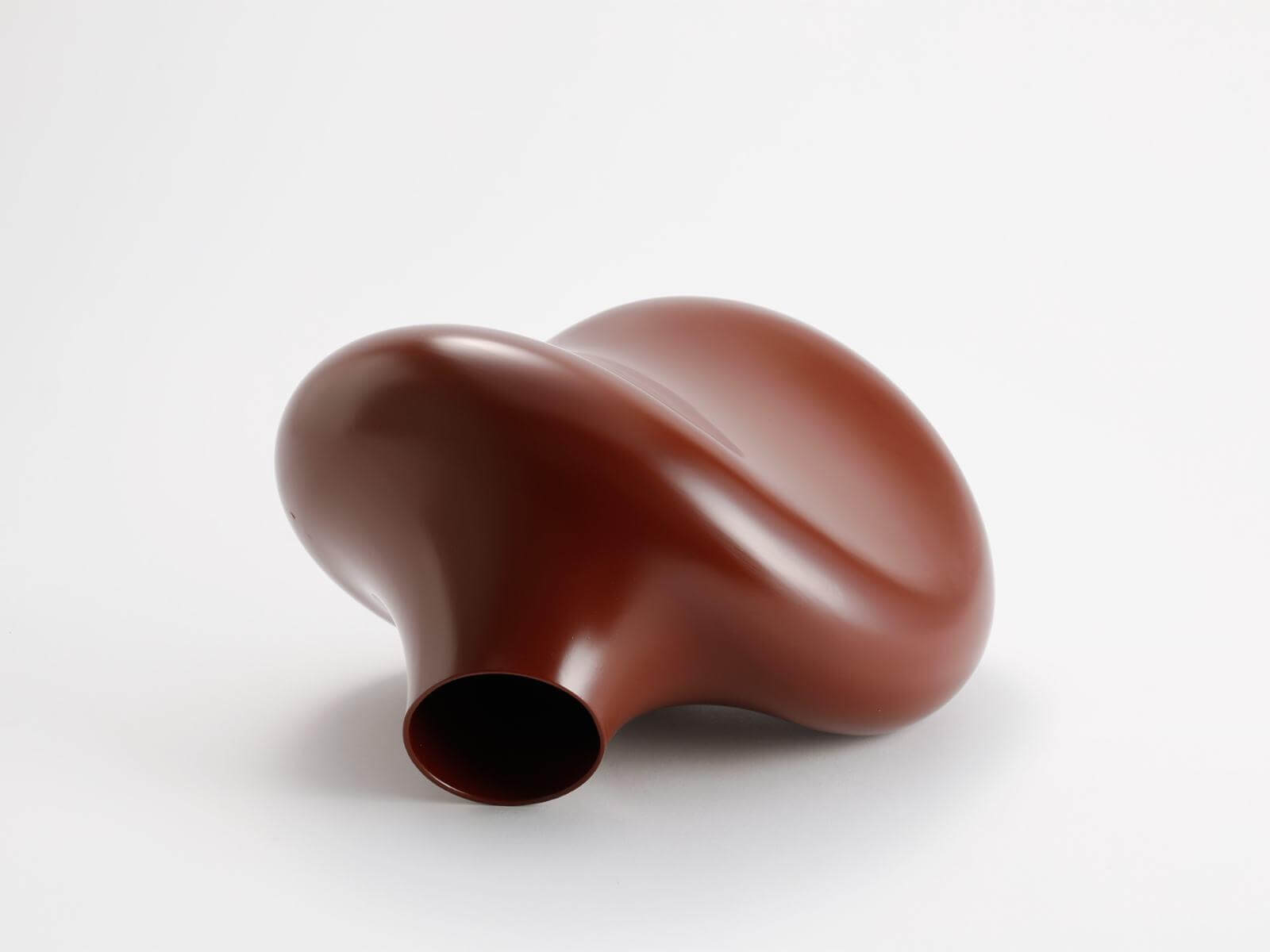
Genta Ishizuka, ‘Membrane Space (bengara)’, 2026
COURTESY: Genta Ishizuka & Erskine, Hall & Coe / PHOTOGRAPH: Takeru Koroda
The surface is like a skin, radiating from within. The marriage of the common industrial tubing he uses and this sublime finish explains part of their allure. Another factor is the sense of the hidden space inside, what Ishizuka refers to as “the enclosure of absence.” This can be enhanced by the addition of surface decoration or Maki-e, where gold leaf or tin powder is sprinkled on the surface, changing the way the forms are read, and creating a further layer of mystery.
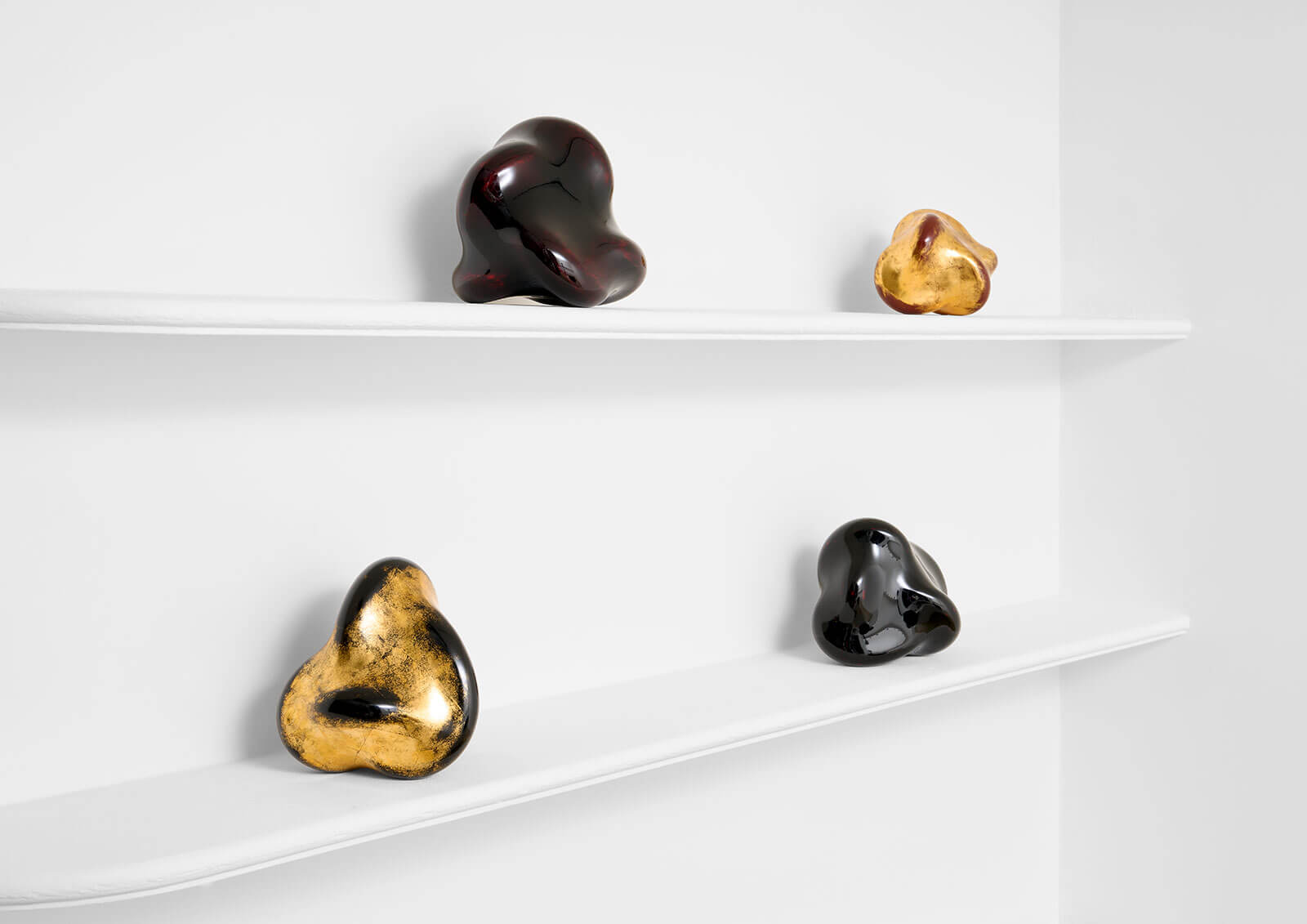
Exhibition view ‘Genta Ishizuka: absence, presence’
COURTESY: Genta Ishizuka & Erskine, Hall & Coe / PHOTOGRAPH: Stuart Burford
Besides new samples of these wonderfully accomplished closed objects, Ishizuka has produced a striking collection of new objects, where an opening is left. He explains that he wanted to experiment with sharing the absence in the object’s heart with his audience. These objects have a different excitement: the unusual forms, also created with industrial tubing, are less closely allied to eternal organic forms such as rocks. Instead, they are reminiscent of body parts – or indeed the industrial parts from which they are formed – , caught in a spasm of movement, but magically transformed by process into objects of beauty and contemplation. There is an unsettling dynamism in the play of interior against exterior, of presence against absence. These pieces have a contemporary energy, held in balance by the immaculate handmade surface.
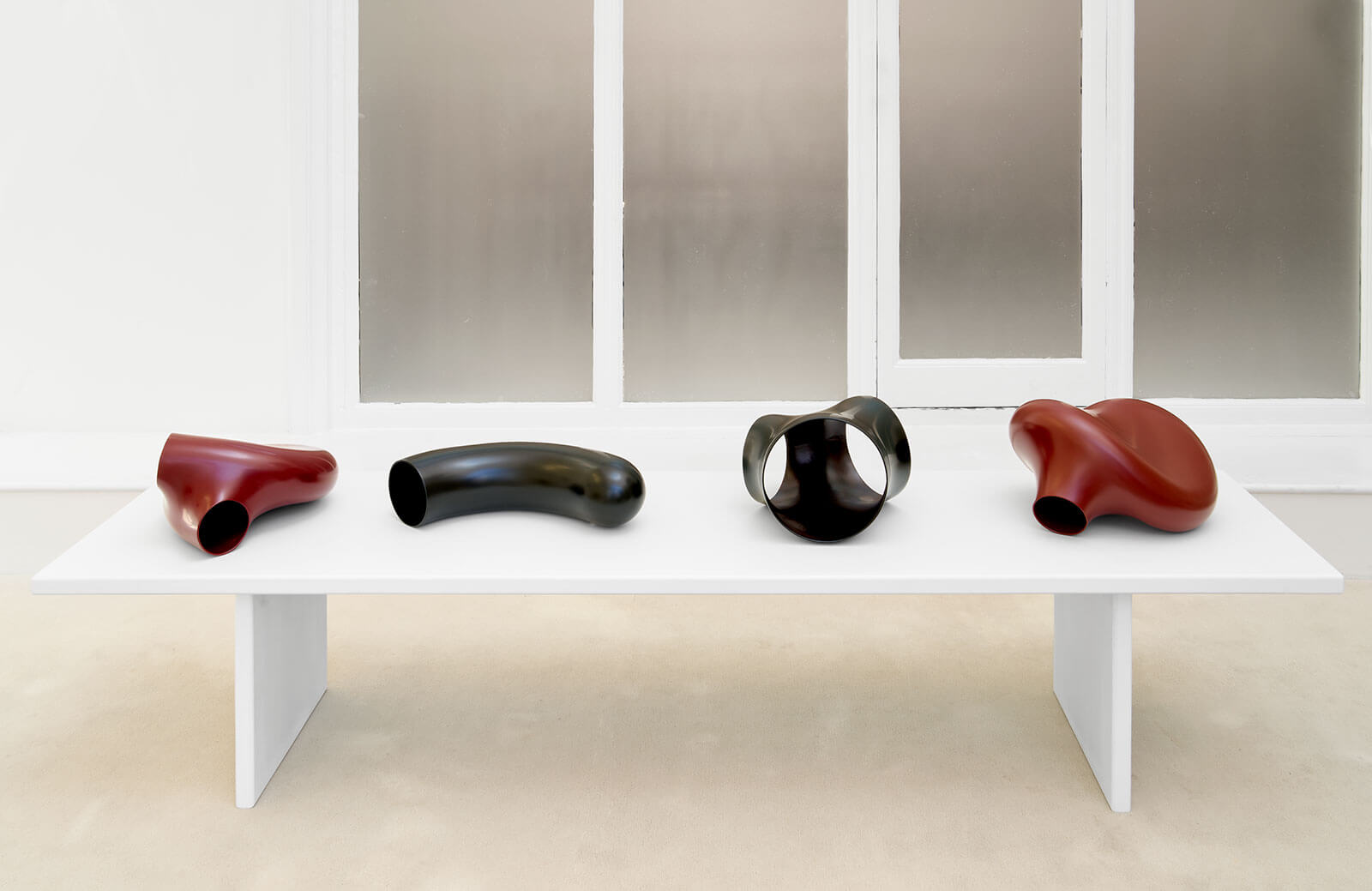
Exhibition view ‘Genta Ishizuka: absence, presence’
COURTESY: Genta Ishizuka & Erskine, Hall & Coe / PHOTOGRAPH: Stuart Burford
‘Barnaby Barford: We Are Where We Are’
David Gill Gallery
Until 30th May
It is fourteen years since Barnaby Barford last worked with porcelain figurines. This show marks a tremendous return to the medium. Harnessing all that he has discovered through his experiments across drawing, sculpture, film, installation, and painting – but drawing on the same drive to understand the place and time he inhabits – Barford has created a beguiling display.
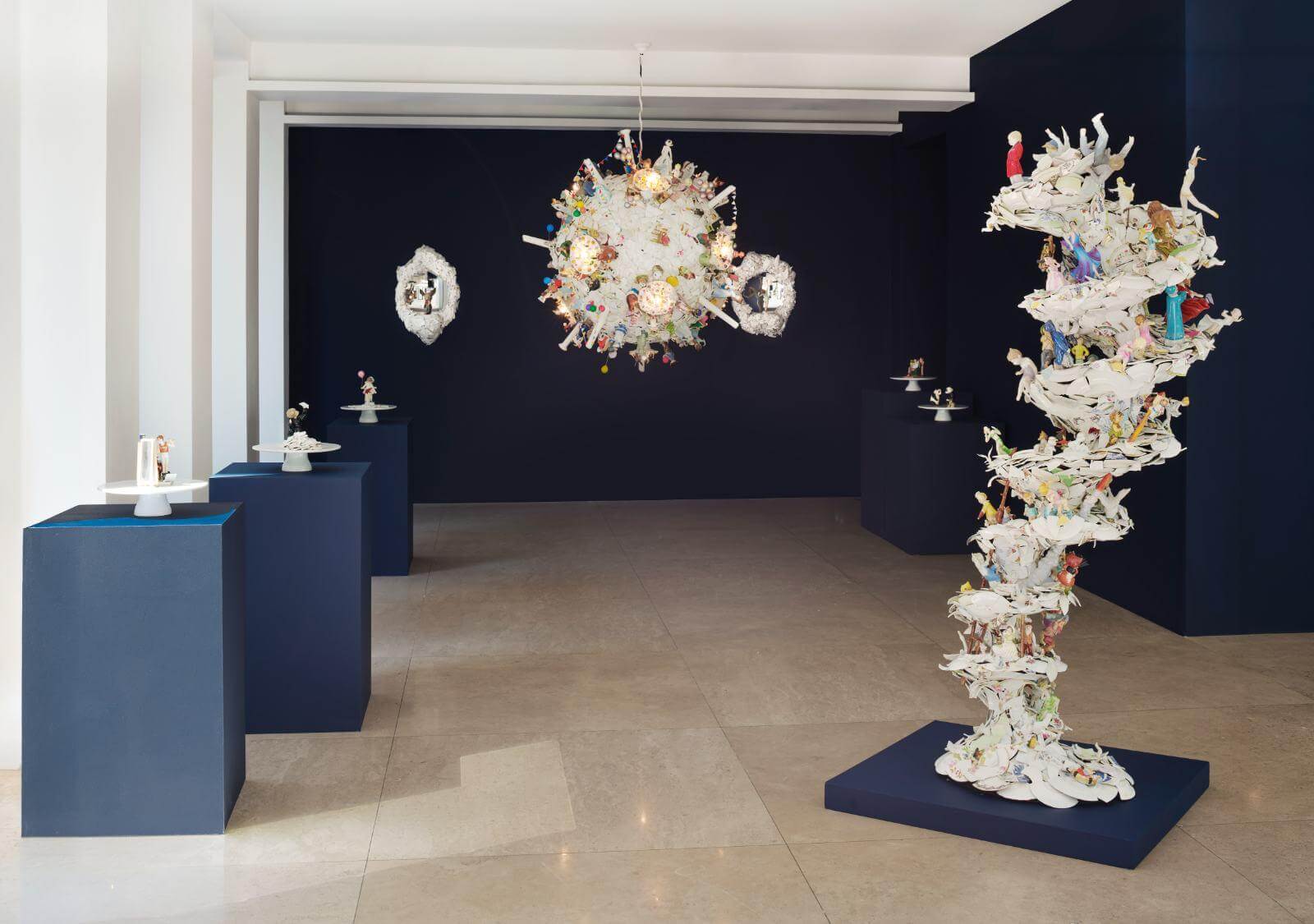
Exhibition view, ‘We Are Where We Are’ COURTESY: Barnaby Barford & David Gill Gallery / PHOTOGRAPH: James Harris
The show features two monumental sculptures constructed from broken crockery and an astonishing plethora of salvaged figurines, some with their own heads, others collages of parts. One piece sees these elements transformed into a spiralling whirligig, where we see embodied our own absurd helplessness in the face of accelerating change. The other, Light Sculpture ‘Feast’, takes the form of a chandelier, or Sputnik circling above us, mirroring back to us the folly of our feasting while the world collapses around us.
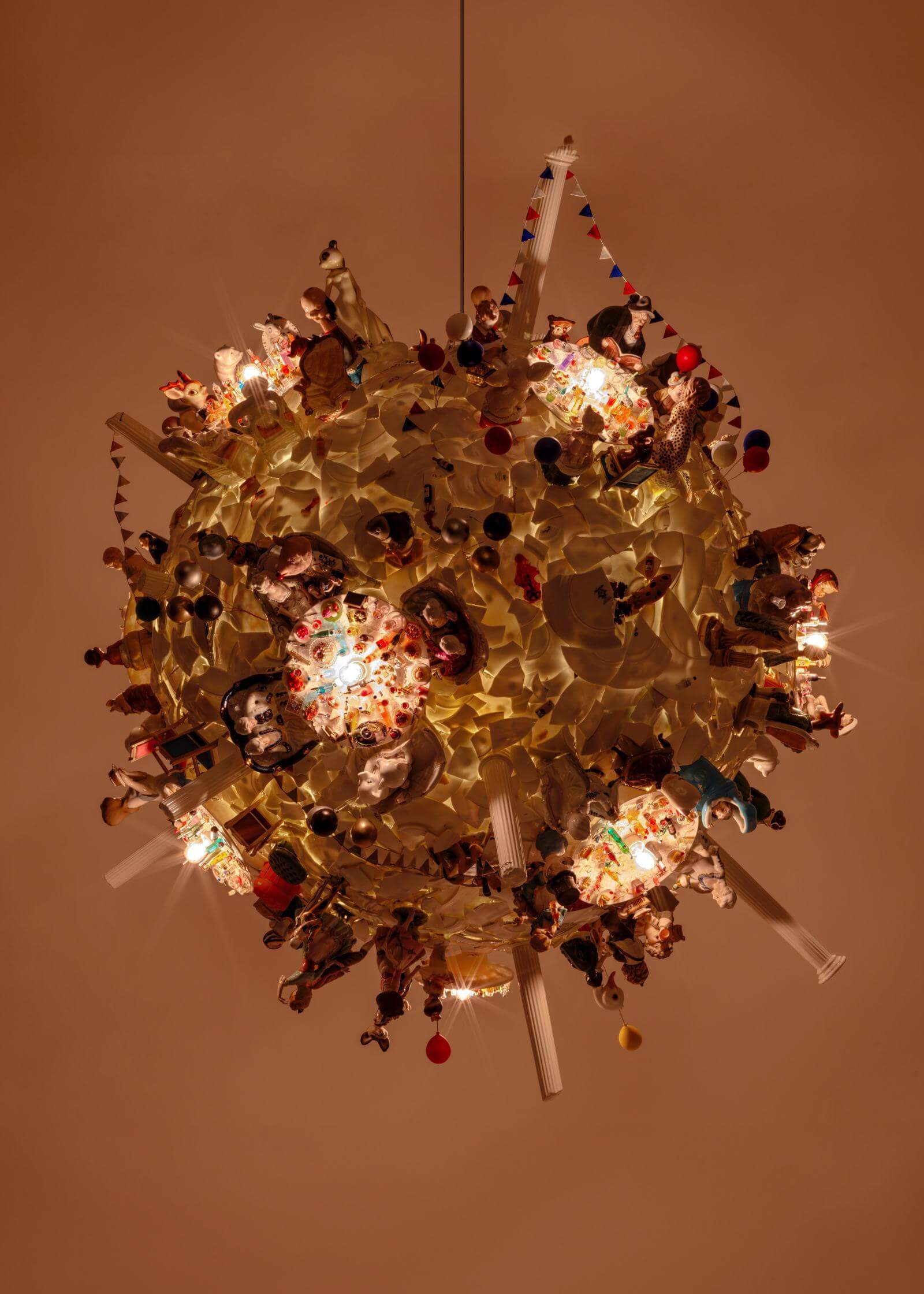
Barnaby Barford, ‘Feast’, 2026 COURTESY: Barnaby Barford & David Gill Gallery / PHOTOGRAPH: Sylvain Deleu
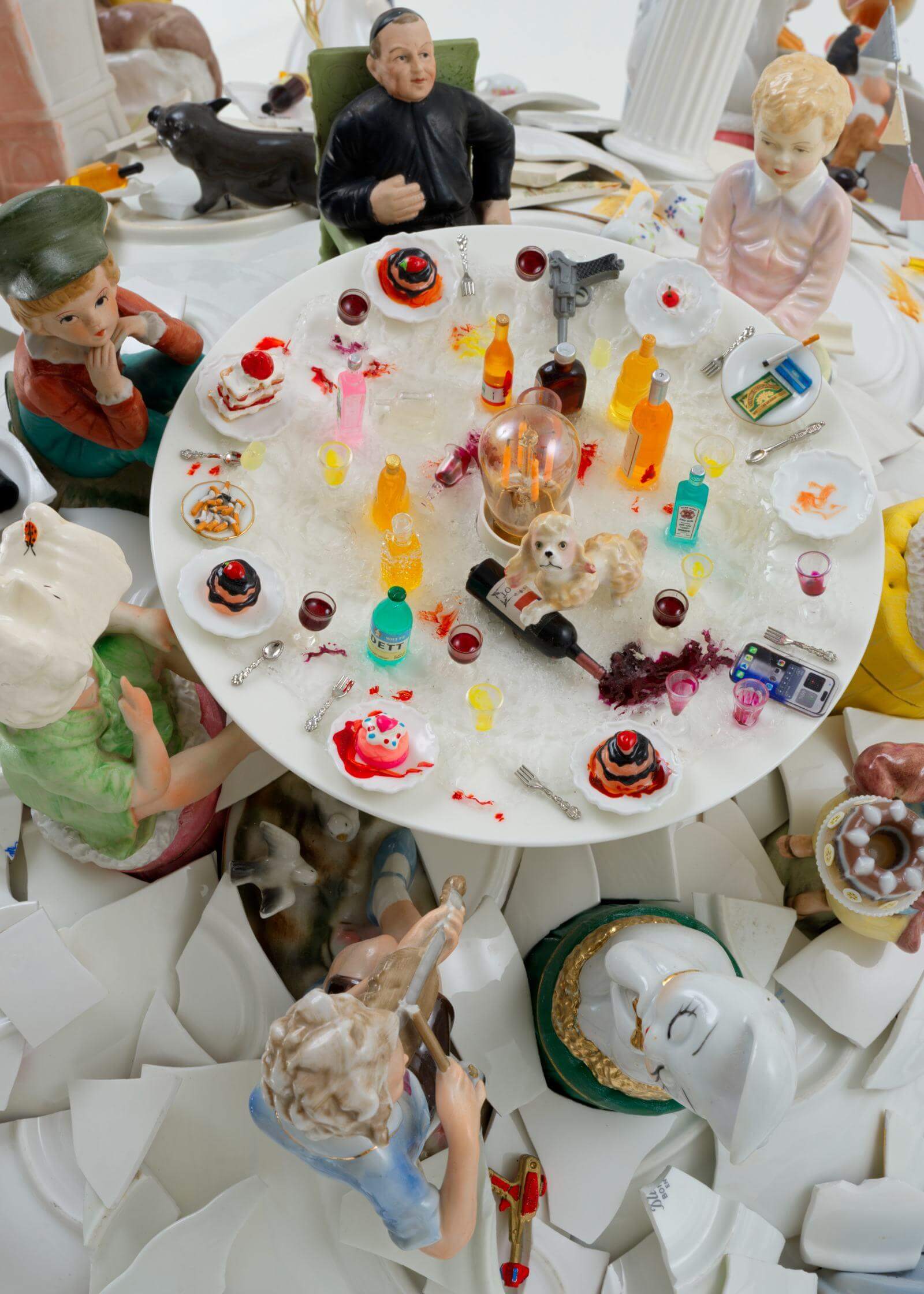
Barnaby Barford, ‘Feast’, 2026 (detail) COURTESY: Barnaby Barford & David Gill Gallery / PHOTOGRAPH: Sylvain Deleu
Barford has used the same method to create a series of mirrors, on the bottom rim of each of which stands a figurine. These are poignant pieces, even as they tease us for our vanity.
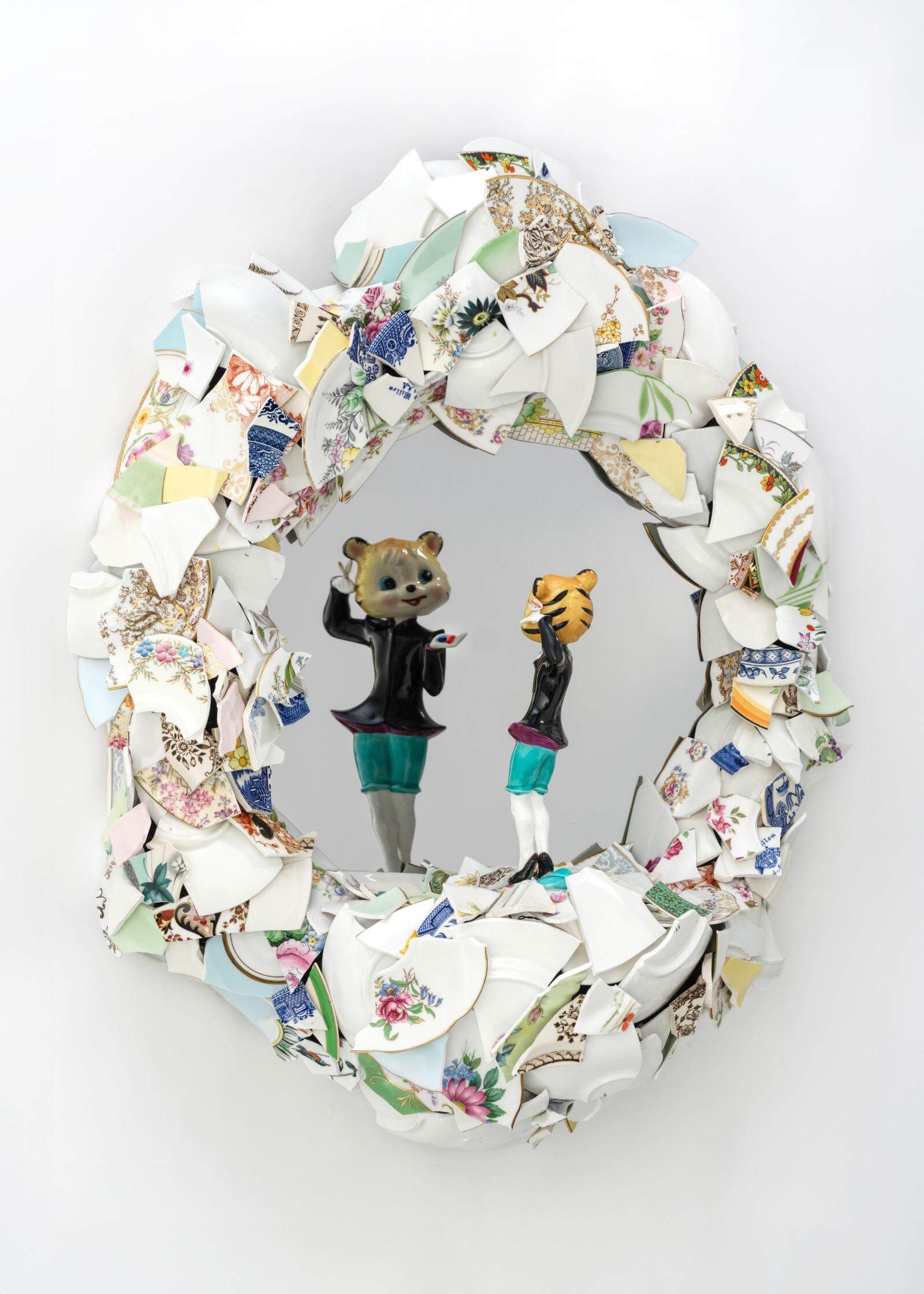
Barnaby Barford, ‘Double Drop’ mirror’, 2026
COURTESY: Barnaby Barford & David Gill Gallery / PHOTOGRAPH: Sylvain Deleu
One giant serpentine mirror is surrounded by figures holding reassuring placards: “Could Be Worse”, “It Is What It Is.” One figurine of a child drowns in debris, his placard, “Someone Should Do Something”, betraying his helplessness and the inertia of all around him. Another large mirror features animal-human hybrid groups, imagined taking the air and picnicking on the shores of Connaught Waters in Epping Forest. Smaller tabletop or plate-sized pieces express satiric rage, or sardonic humour, by turns.
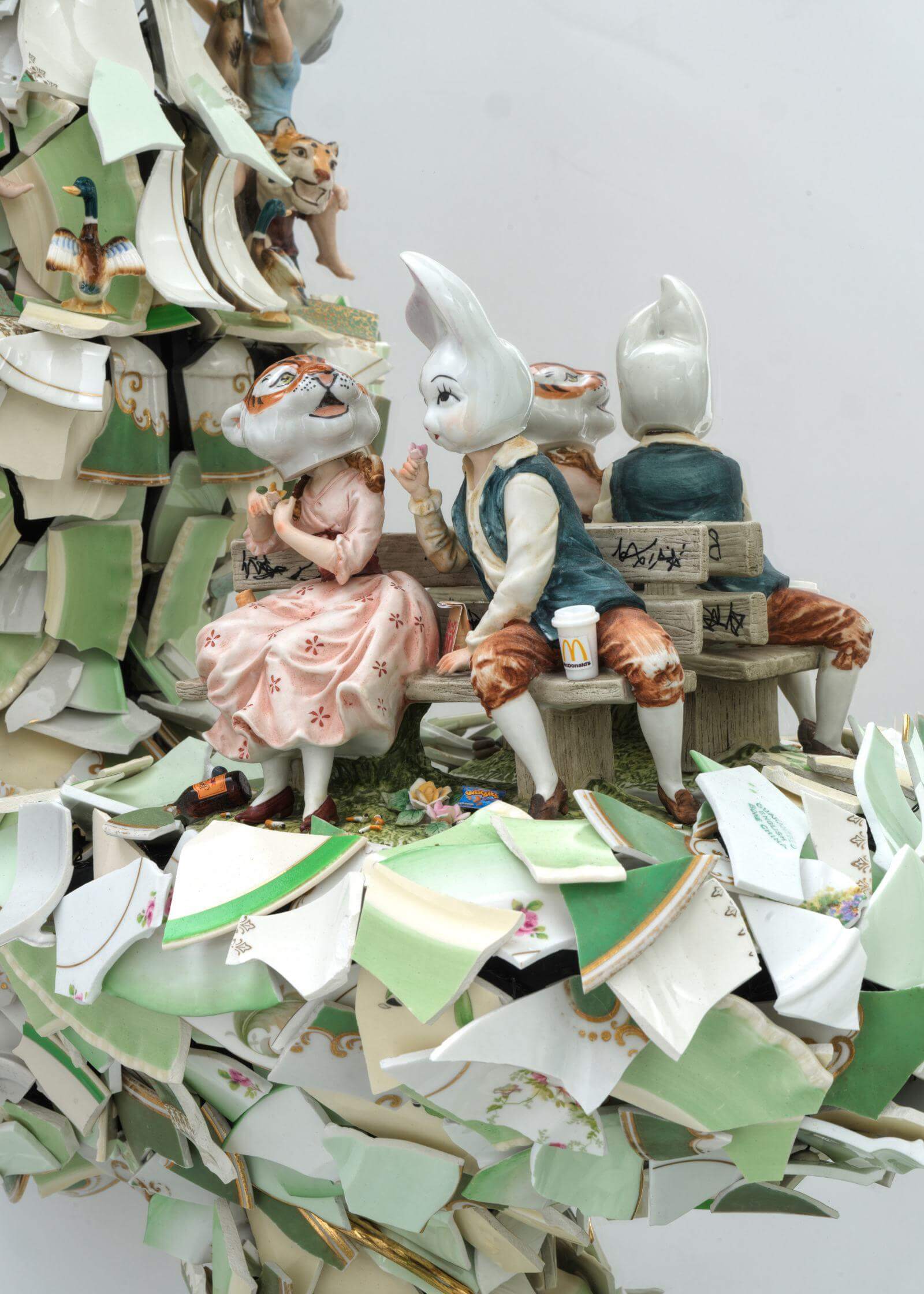
Barnaby Barford, ‘Sunday Afternoon on Connaught Waters’, 2026
COURTESY: Barnaby Barford & David Gill Gallery / PHOTOGRAPH: Sylvain Deleu
For all Barford’s despair and anger at the world, however, these are beautiful pieces: the selection of broken crockery is painterly, and the wittily staged figures conjure cosy nostalgia even as they disallow it. Barford writes in the press release, “It feels like I am speaking a language I haven’t used in a long time.” He need not worry. He is fluent in it.
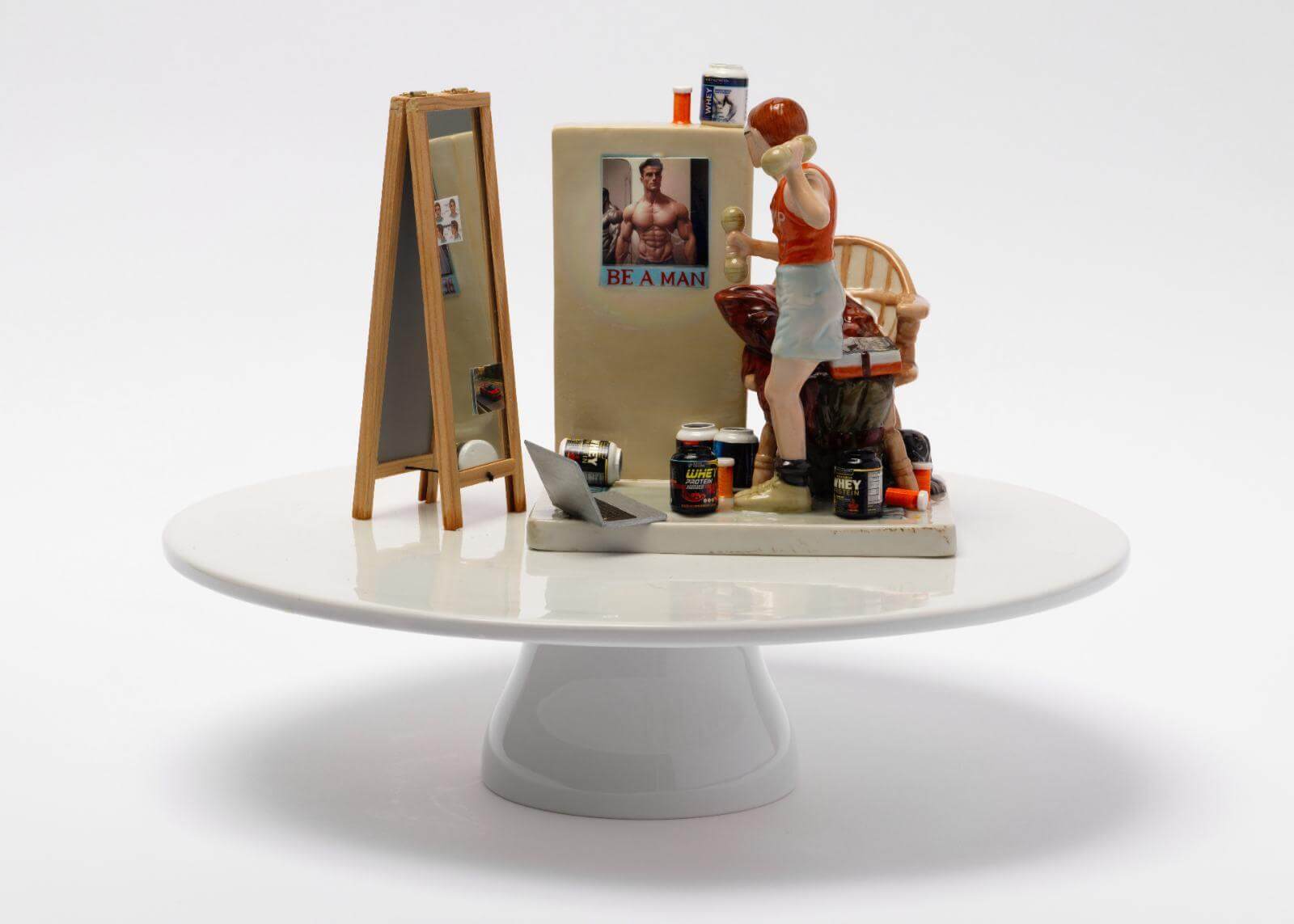
Barnaby Barford, ‘Ascension’, 2026
COURTESY: Barnaby Barford & David Gill Gallery / PHOTOGRAPH: Sylvain Deleu
‘Ken Price’
Lisson Gallery
Until 25th July
This is the first solo show of Ken Price’s work in London for almost a decade. It is well worth the wait. This Los Angeles-born artist, who lived and worked mostly in Venice, California, before moving permanently to New Mexico in the early 2000s, died in 2012, but his works have an undimmable visceral impact.
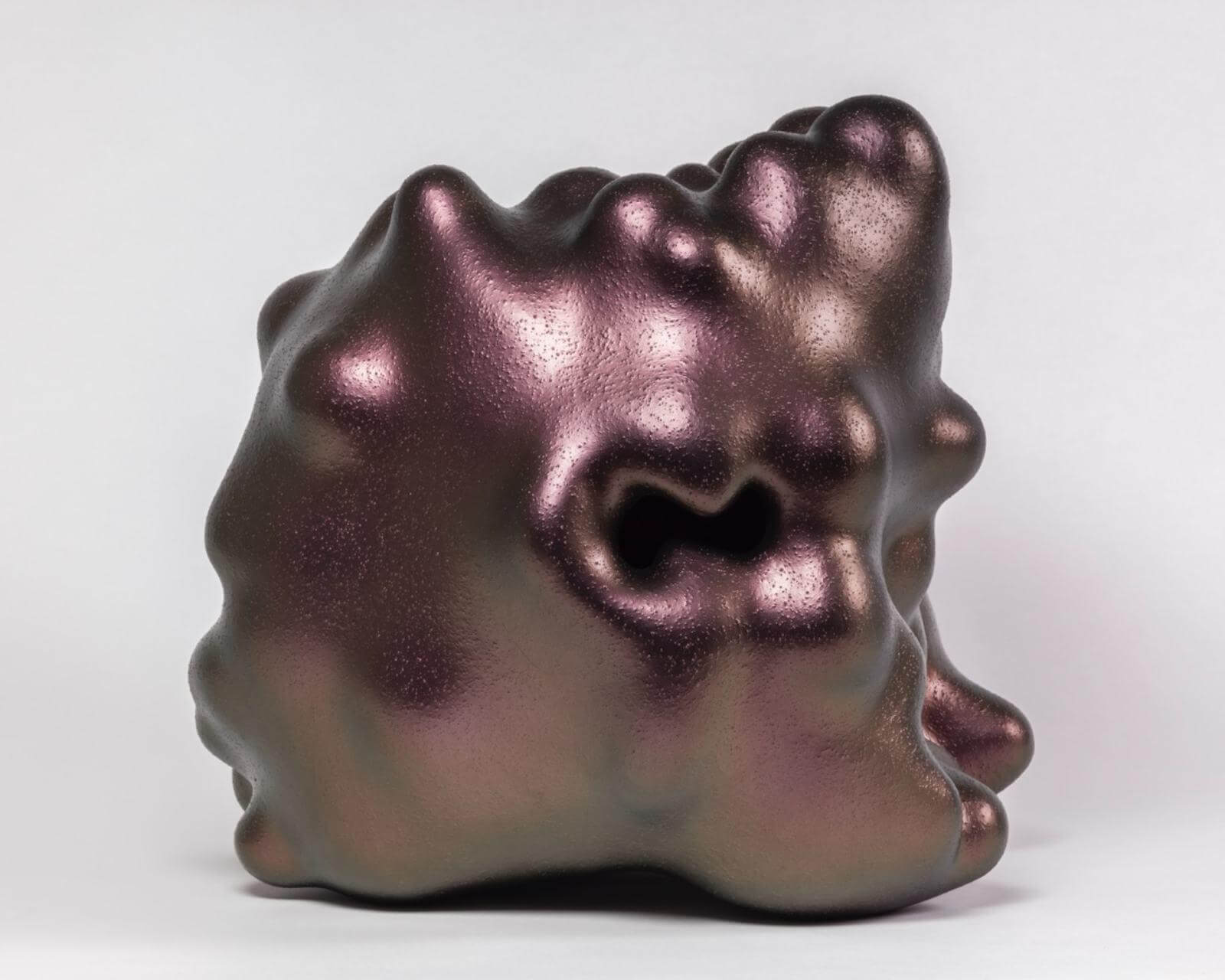
Ken Price, ‘Untitled’, 1996
COURTESY: Ken Price & Lisson Gallery
From his early twenties, Price was committed to ceramics as a way to explore his unique moment in history. A student at Otis Art Institute in LA, under the charismatic Peter Voulkos (the heroic father figure of sculptural ceramics in the USA), Price was also a technical perfectionist. He committed decades to the study of glazes and to experiments with the application of acrylic paint onto his mesmerising surfaces. But as important as other ceramicists was the burgeoning art scene in LA in the 1960s, where Price was part of an era-defining movement that included Robert Irwin, John McCracken, Ed Ruscha, Peter Alexander and others.
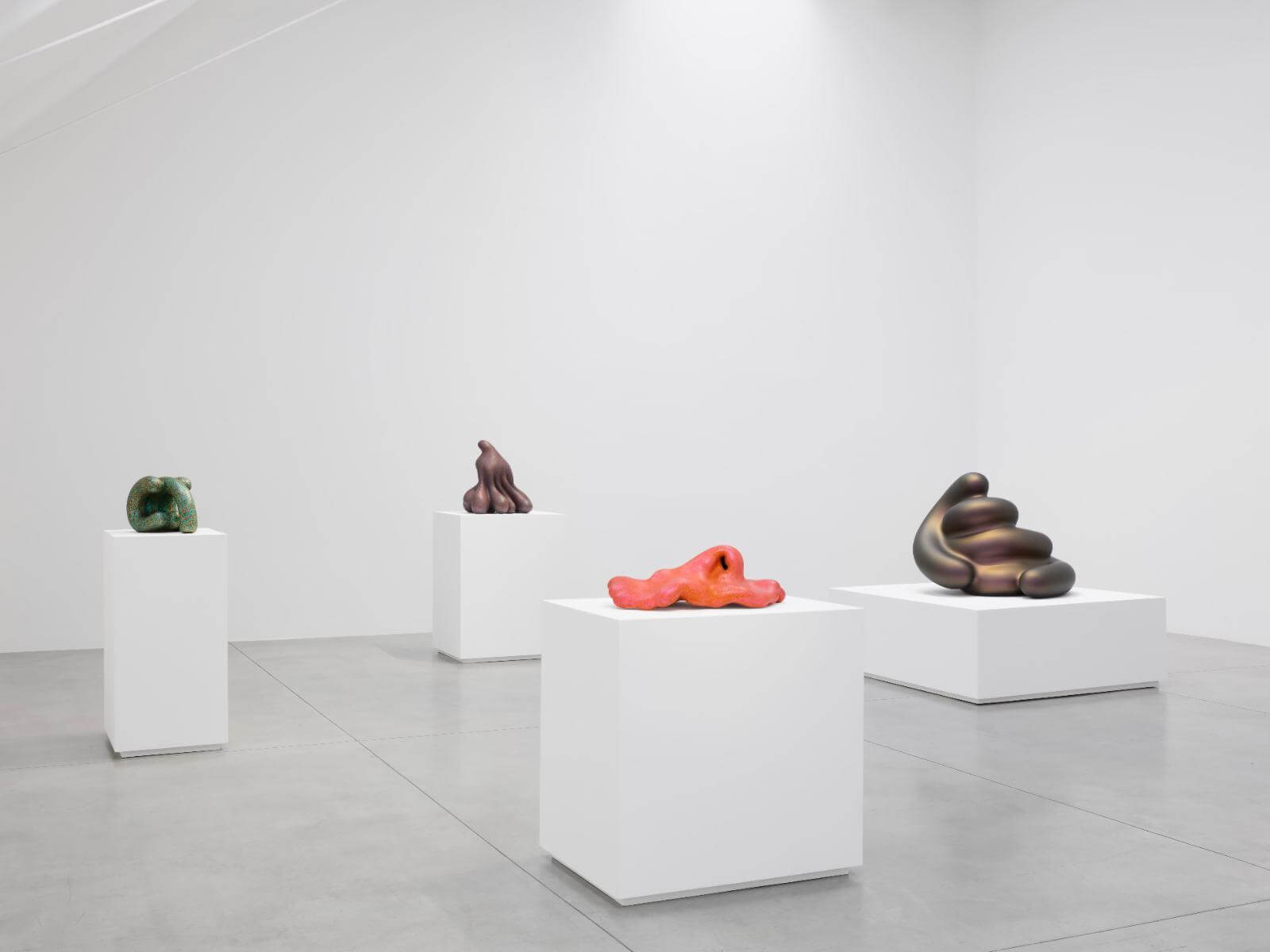
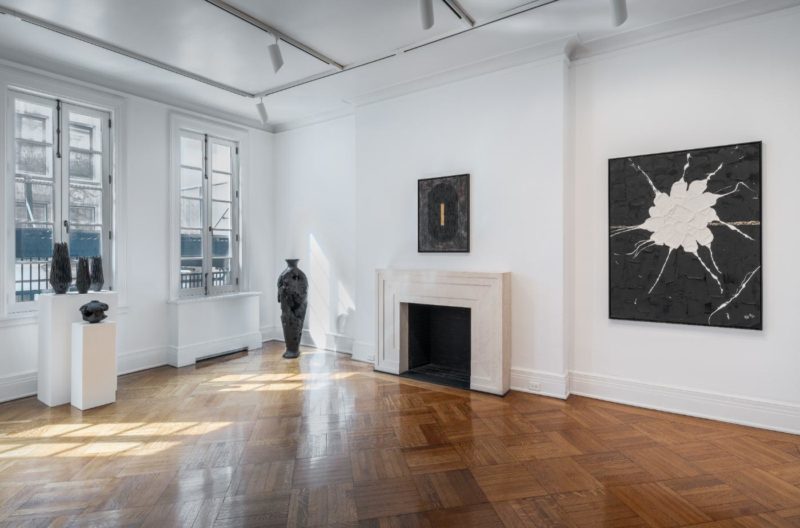
Exhibition view, ‘Ken Price’
COURTESY: Ken Price & Lisson Gallery
Absorbing influences as diverse as Mexican pottery, Hollywood films, jazz, surfboard aesthetics and East Coast Pop Art, Price began as early as the 1960s and 1970s to produce potent, eerie objects in clay, enlivened by their immaculate brightly coloured tactile surfaces.
-

-
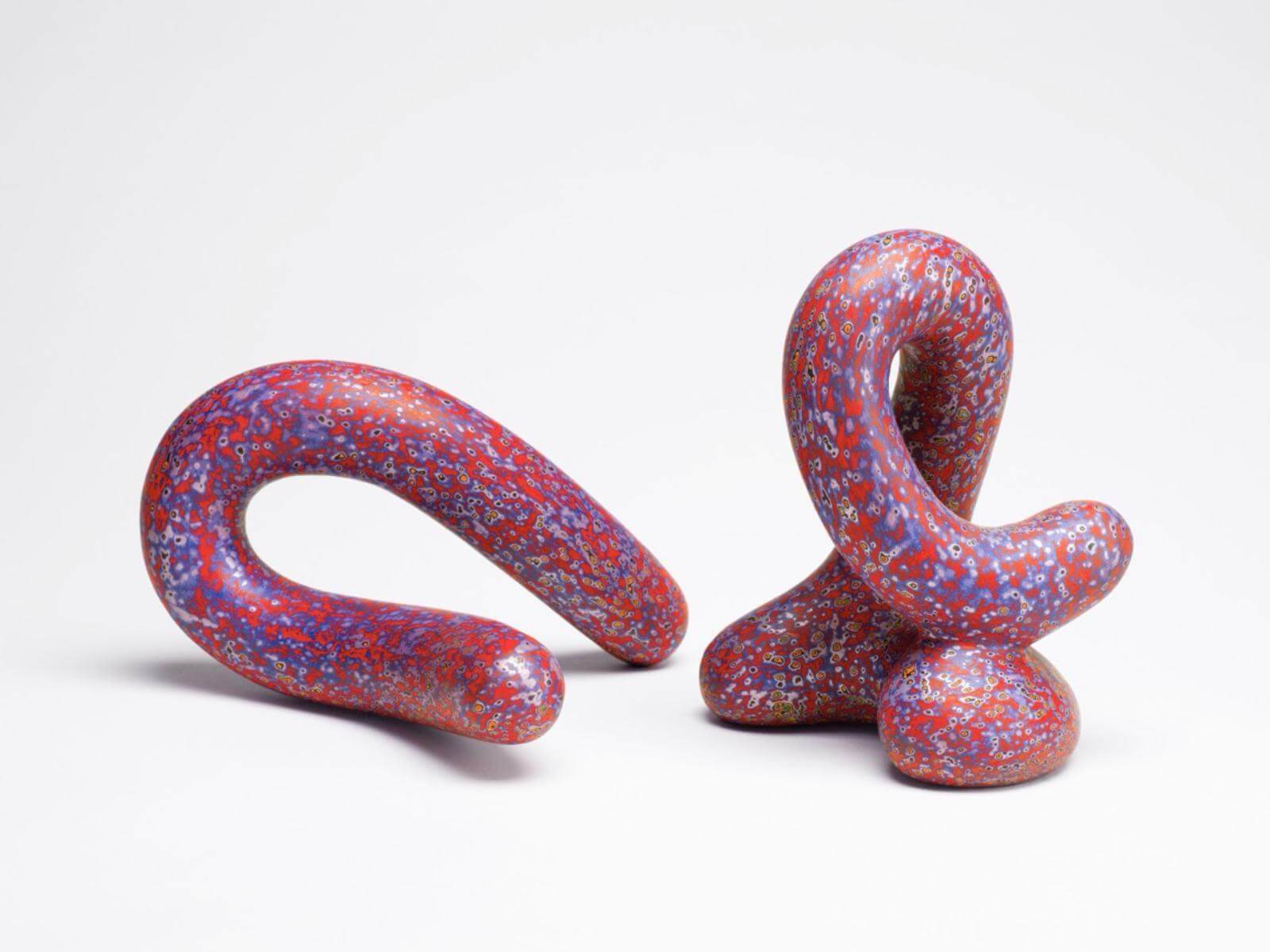
Ken Price, ‘Bloop’, 2009
COURTESY: Ken Price & Lisson Gallery
-
-
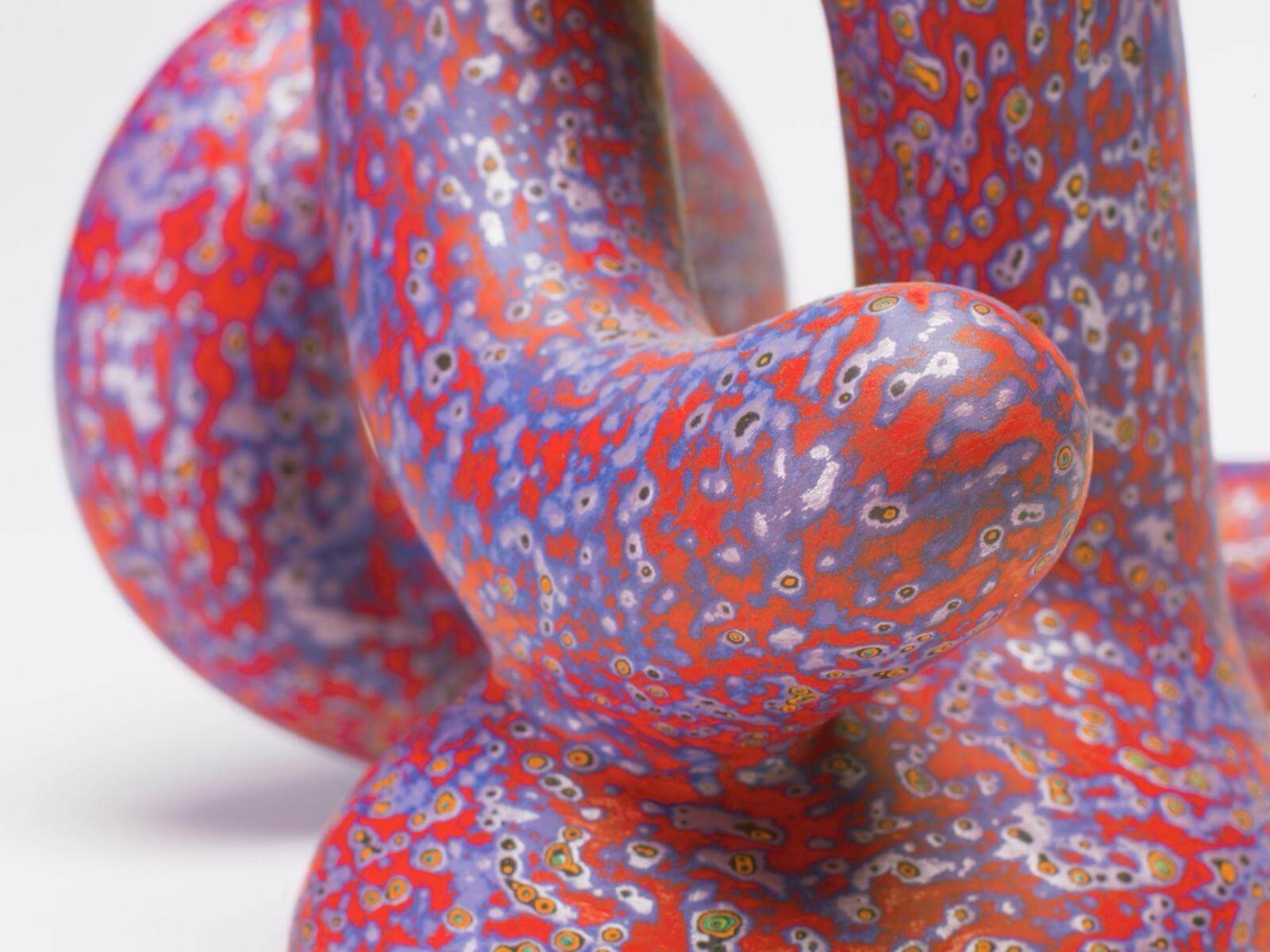
Ken Price, ‘Bloop’, 2009 (detail)
COURTESY: Ken Price & Lisson Gallery
-

-
Ken Price, ‘Nicabar’, 2007
COURTESY: Ken Price & Lisson Gallery
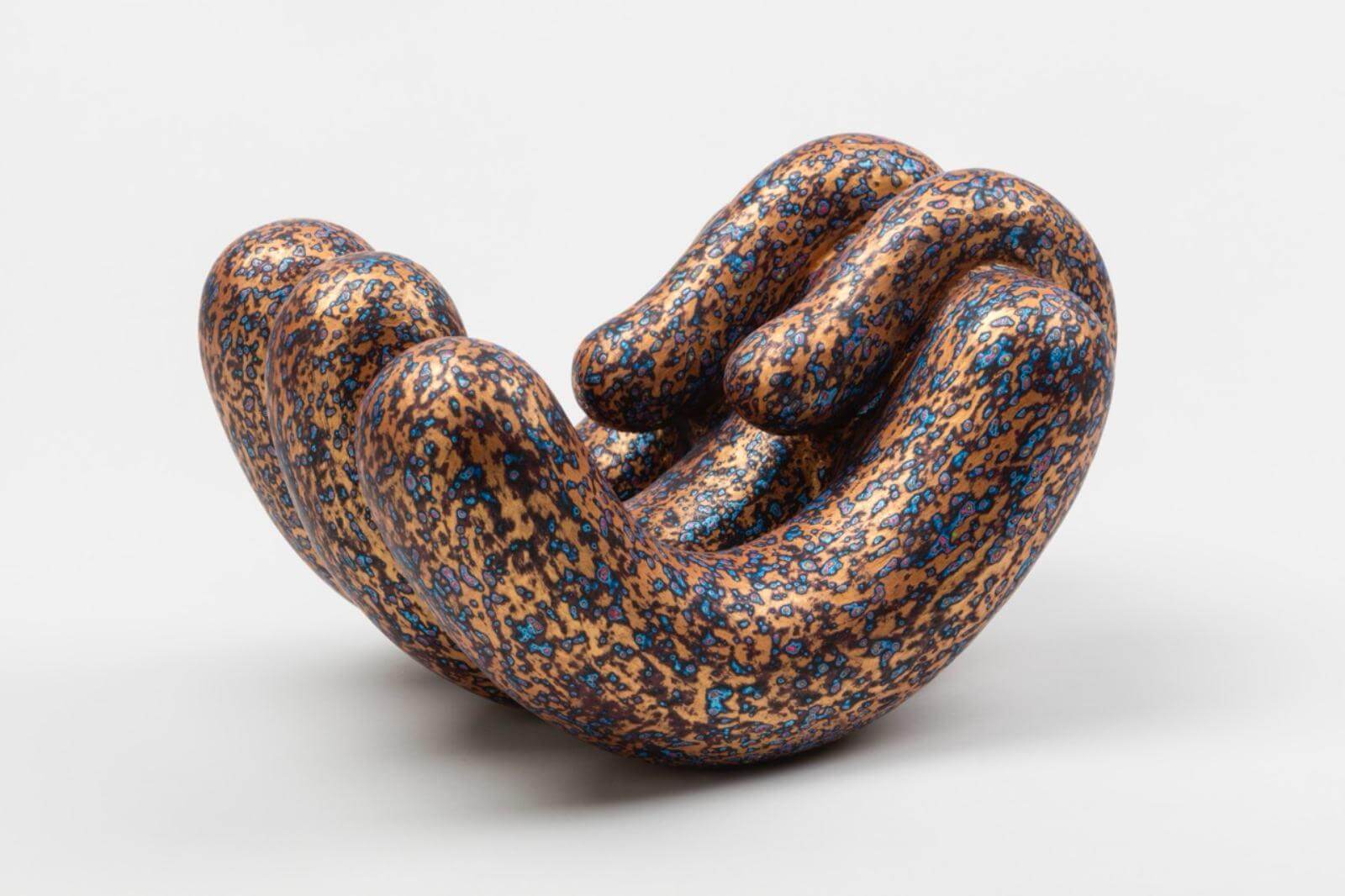
Divorced from functional ceramics, Price’s works are definitively sculptures. Neither quite figurative, nor quite abstract, they confront you with their erotic sensuality, seduce you with their scintillating surfaces, and then, teasing further with their enigmatic titles, elude any specificity of reference. It is as if they represent forms from an alien planet – a Martian bestiary.
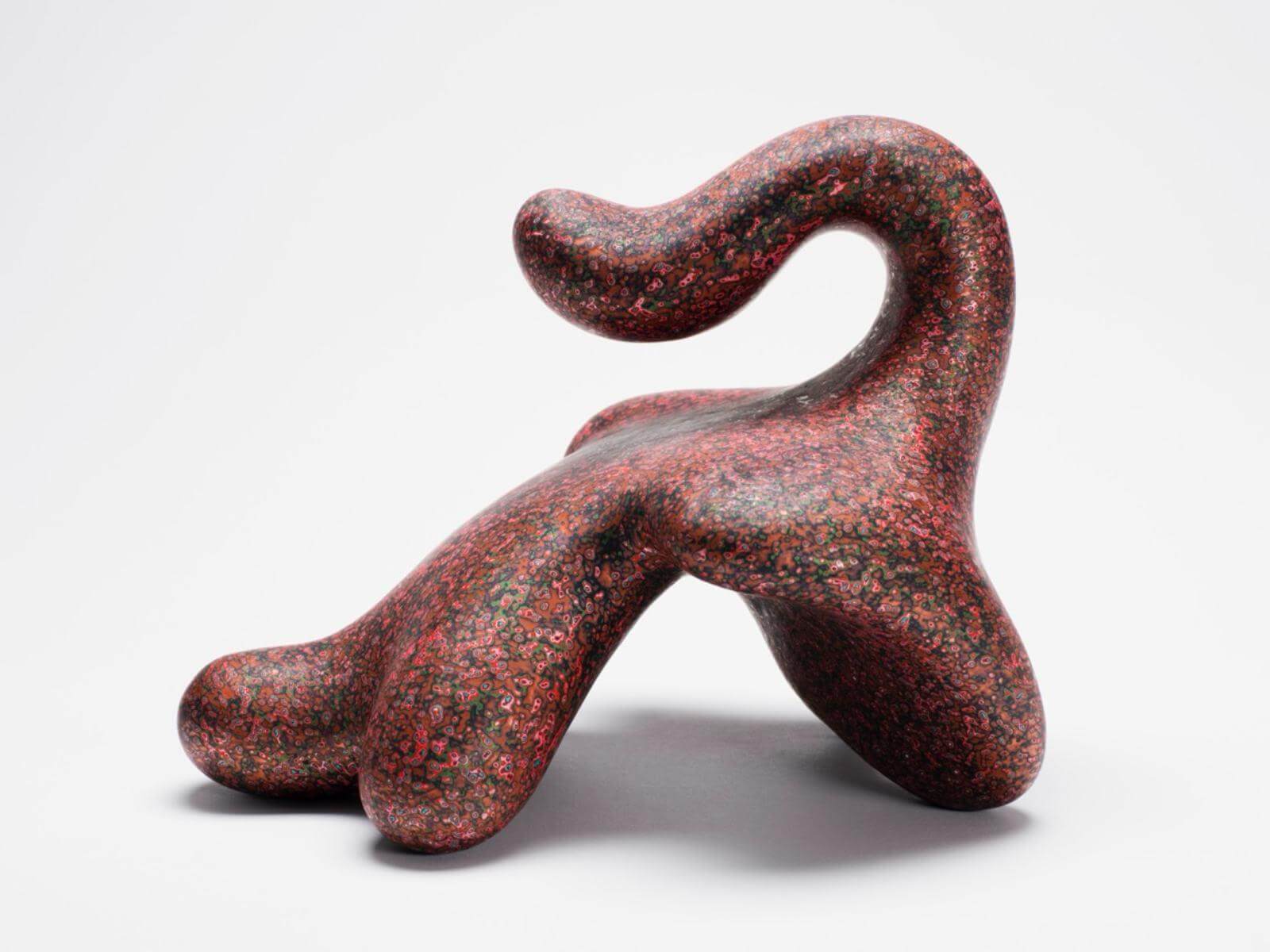
Ken Price, ‘Sweet Cakes’, 2002
COURTESY: Ken Price & Lisson Gallery
This show, presented in collaboration with Matthew Marks Gallery, based in New York, brings together drawings and sculptures from the last sixteen years of his life, including two large pieces in painted bronze composite. In this material, his dextrous and witty imagination could finally take up the challenge of scale offered by the landscapes of New Mexico.
Part II of May’s London Dispatch to follow.