Preview / PAD London 2026
Malaika Byng previews six designers and galleries to look out for at PAD London.
Berkeley Square,
London
13th – 18th October
By TDE Editorial Team / 9th October 2026
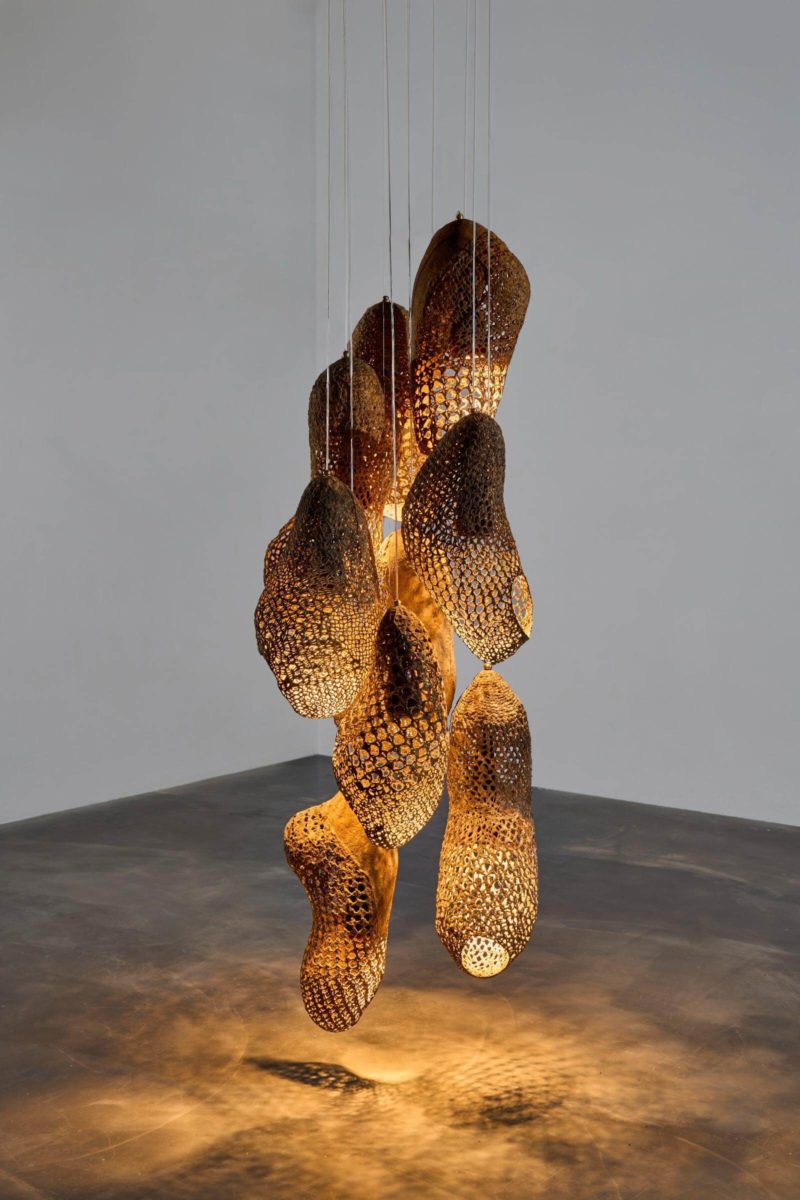
Kyeok Kim, ‘Surface of Memory 02’, 2025
COURTESTY: Charles Burnand Gallery & PAD London
PAD LONDON RETURNS to Berkeley Square this month amid a surge of optimism in the design market after a shaky couple of years in the broader art world. Auction sales in collectible design rose by 63% year-on-year in the first half of 2026, according to Bank of America Fall 2026 Art Market Report, making it one of the market’s fastest-growing categories – and galleries will be hoping to build on this success.
For its 18th edition, PAD London brings with it an enticing cache of 12 new galleries and designers with presentations produced outside of the design world’s established centres: Lloyd Choi Gallery, for example, will focus on contemporary material-led practices in South Korea, and Initio Arts & Design will spotlight art and collectible design from Eastern Europe. They are joined by big-hitting PAD regulars, such as New York’s Friedman Benda and Paris’s Galerie Kreo. Here, we preview the highlights.
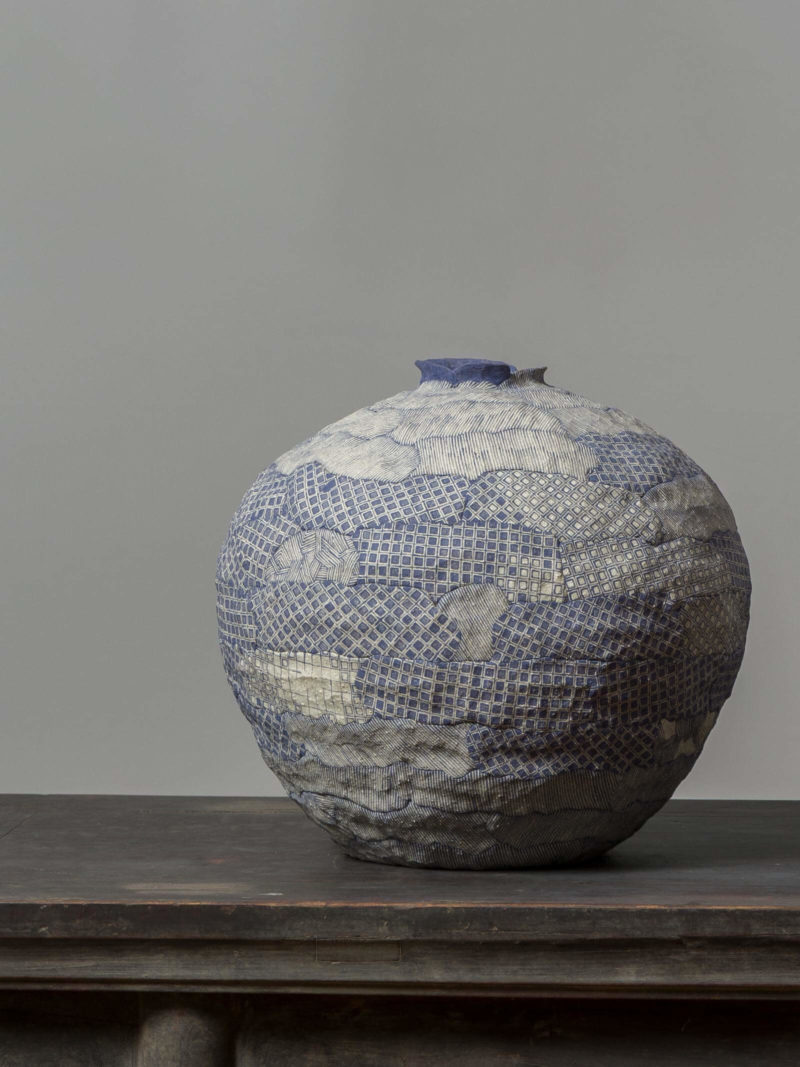
Choi Boram, ‘Blue Jar – Undoing No. 4’, 2025
COURTESY: Lloyd Choi Gallery & PAD London / PHOTOGRAPH: Leon Kong
Hypnotic textiles by Ptolemy Mann
Tristan Hoare’s booth will host a mesmerising trio of works by Ptolemy Mann that blur the boundaries between textile and painting. Mann became fascinated by colour as a child after noticing the distinctive emotional effects of placing two tones side by side, a curiosity that has become an obsession in later life. “The fibre I weave with is very much secondary,” explains the British artist, who often draws from the saturated colours used by Mexican architect Luis Barragán. “What I’m really interested in is the surface – a smooth articulate surface that delivers colour in a pure way.” Mann hand-dyes each thread herself before placing it on the loom, in a process that is entirely handmade, which gives her “an incredibly close relationship with her material,” explains Hoare. “Her skill translates into her ability to create planes of colour that vibrate and emit a quiet intensity.” PAD will offer a taster of her work, ahead of her first solo show with the gallery, ‘Chromatic Minimalism’, opening on 5th November.
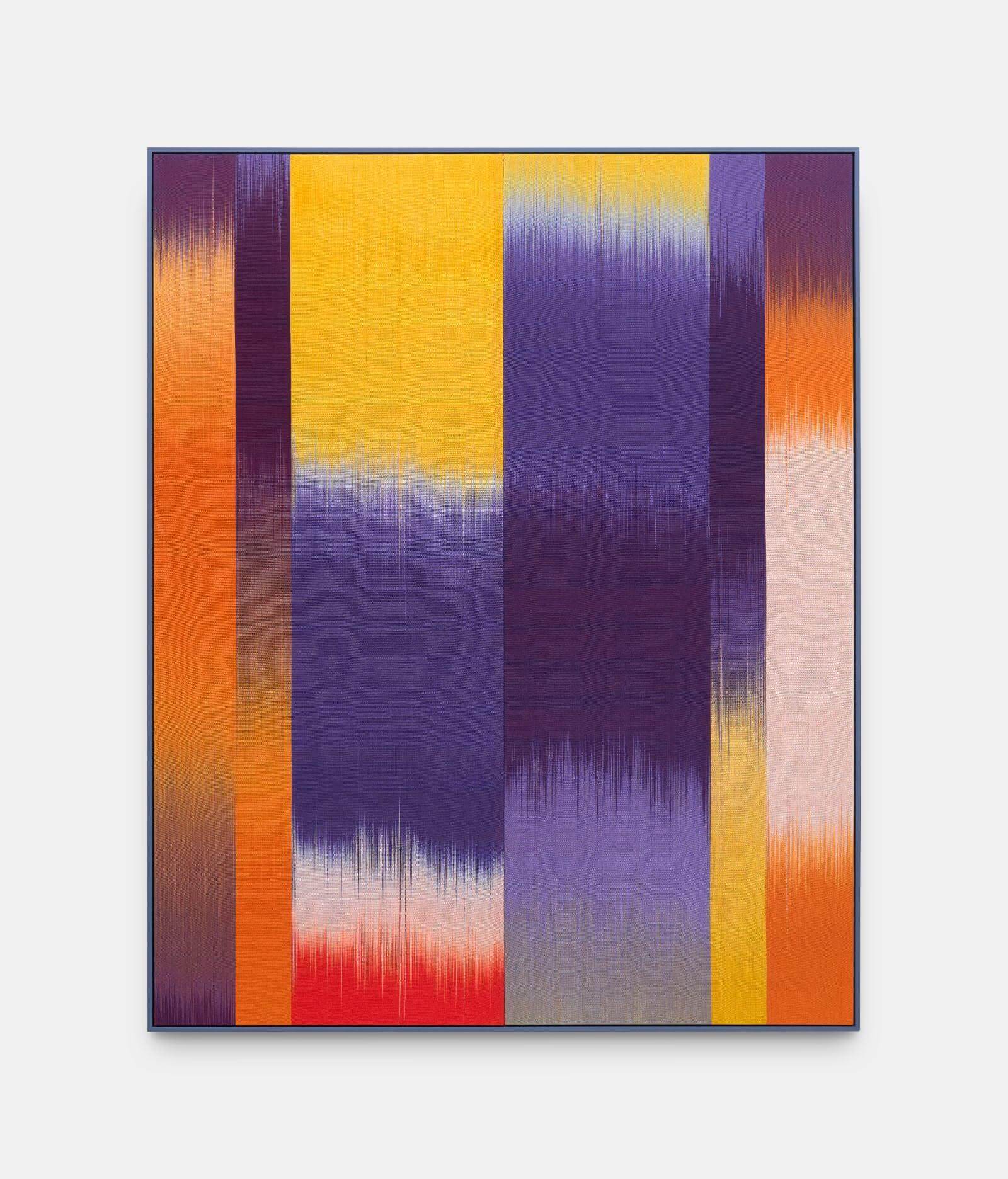
Ptolemy Mann, ‘Yellow Violet Dynamics’, 2025
COURTESY: Tristan Hoare Gallery & PAD London
The return of the shingle
Timber shingles – staples of building vernaculars around the world from Scandinavia to New England, USA – are making a comeback in architecture, art and design. Architecture practice Okra recently used hand-cleft oak shingles to clad its 2026 RIBA National Award-winning Apple House in Hertfordshire, for example, while the artist Wycliffe Stutchbury (a former PAD exhibitor with Sarah Myerscough Gallery) cloaks both gallery walls and building facades with rippling artworks made from found timber. At this edition, Gallery Fumi will show the work of Berlin-based designers Lukas Wegwerth and Corinna Dehn, who have taken cues from architecture in Germany’s Vogelsberg region, where they have a studio, and natural patterns, such as fish scales, butterfly wings and the plated shell of the armadillo to create a characterful collection of furniture pieces that extends across Fumi’s Hay Hill exhibition space. “What I always find very striking about it is that, if it’s used on a facade, it becomes almost like a skin for a house but it’s at the same time, something very alive,” explains Dehn. The shingles are made from beams from Vogelsberg barns and centuries-old homes, stained with natural pigments.
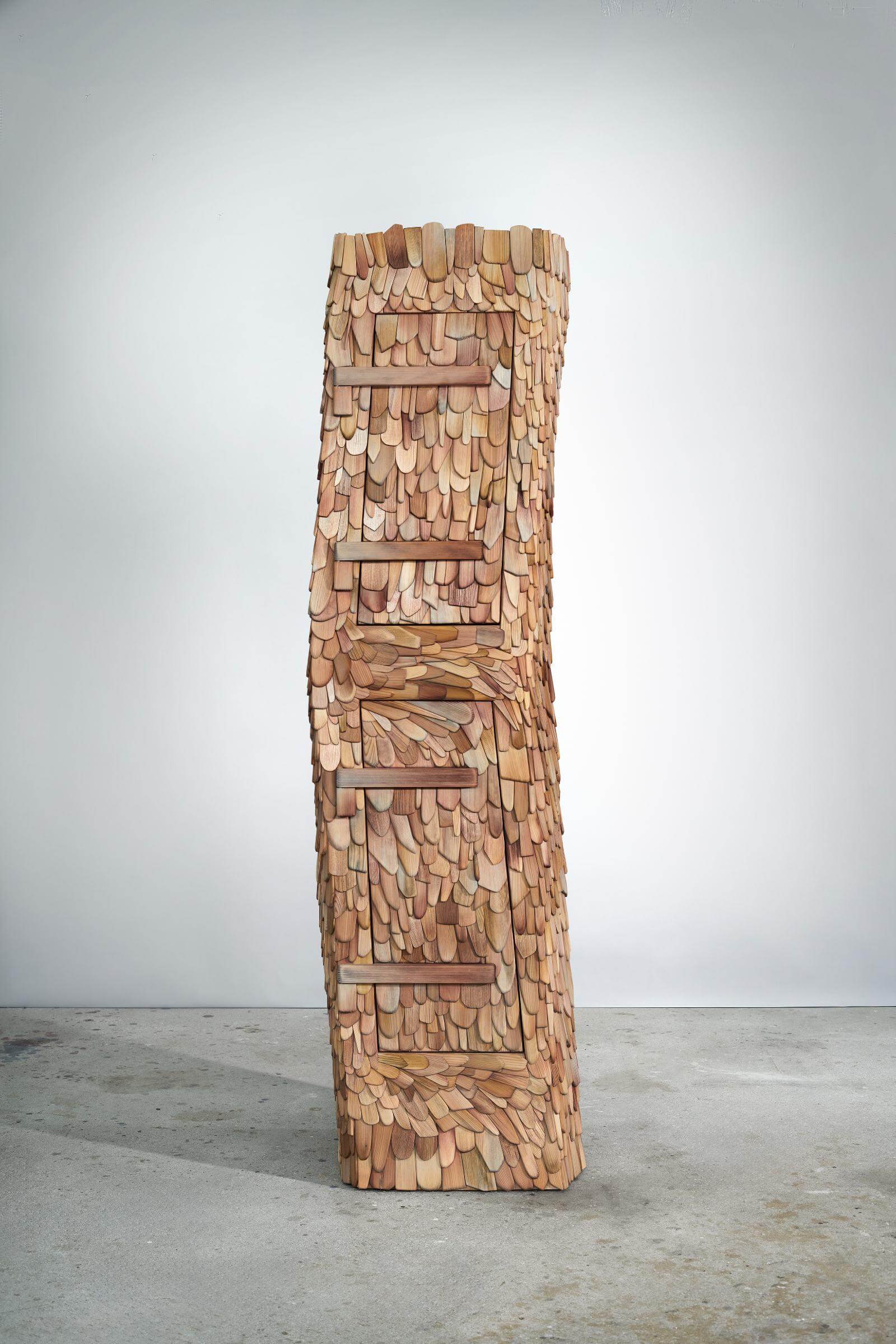
Lukas Wegwerth and Corinna Dehn, ‘Armadillo’ cabinet, 2026
COURTESY: Gallery FUMI & PAD London / PHOTOGRAPH: Moritz Wegwerth
Moon jar magic
The classic white moon jar – typically made from two porcelain hemispheres, joined at the centre – has been a mainstay of Korean ceramics since the 17th Century, riffed on by ceramicists around the world. “It endures because it is not a perfectly round form designed with precision but the result of material properties, gravity, heat and process,” says Lloyd Choi, whose eponymous gallery will exhibit at PAD for the first time. “Its beauty lies in this ‘born rather than made’ aspect, which allows unexpected outcomes to emerge.” Korean artists continue to push this cultural icon in fresh directions, including the gallery’s Jucheol Yun, who combines modern casting with a reinterpretation of ‘guiyal buncheong’, a 14th-century Korean technique in which slip is applied with a rice-straw brush, to create a tactile, thorn-like texture. He calls this his ‘cheomjang’ technique, which Choi describes as, “a method rooted in tradition, but developed as a way forward rather than a repetition of the past.” Meanwhile, Jaiik Lee (showing with LVS & Craft) reimagines the moon jar in copper, polished to resemble the appearance of porcelain with his series, ‘Transition’.
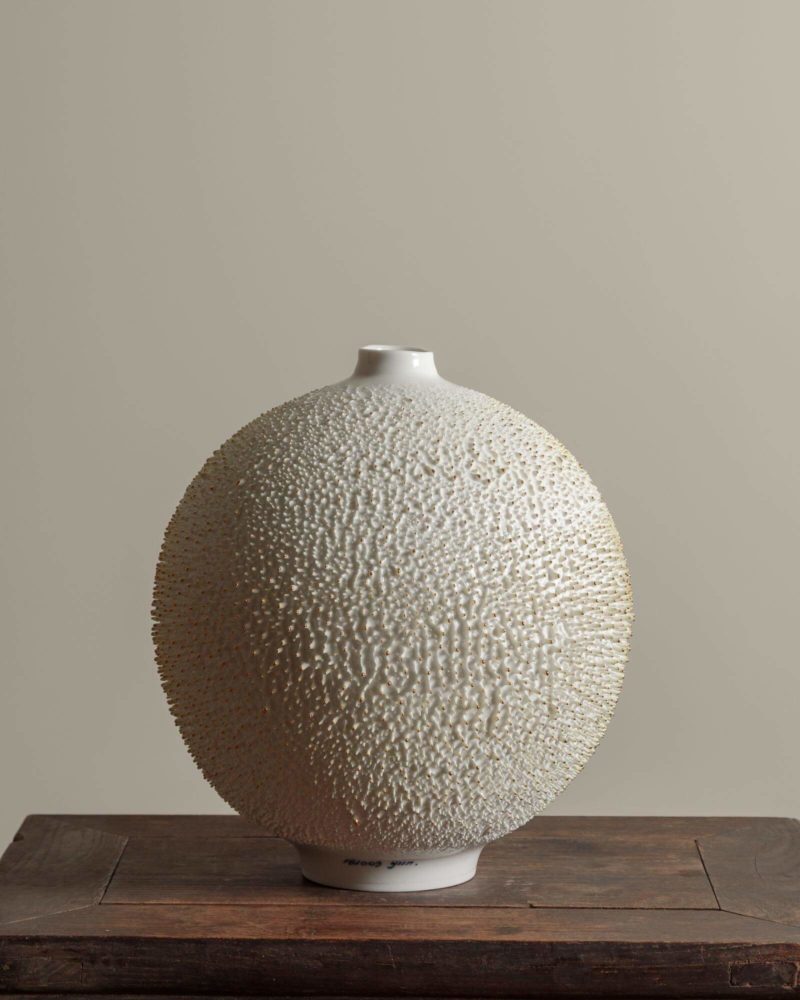
Jucheol Yun, ‘Cheomjang Moon Jar 181003’, 2018
COURTESY: Lloyd Choi Gallery & PAD London / PHOTOGRAPH: Inge Clemente
A humidor with a difference
The functional sculptures of French art power couple François-Xavier and Claude Lalanne continue to smash auction records. The former’s copper ‘Hippopotame Bar’ became the most expensive design object ever sold when it fetched $31.4 million at Sotheby’s New York in December 2025, swiftly topped by an ensemble of 15 mirrors framed in botanical motifs in bronze and galvanised copper by Lalanne, which went for a whopping $33.5 million with Sotheby’s in April 2026. At PAD London, Mathivet Galerie is offering a more affordable entry point into the Lalanne world than these one-off pieces, in the form of a pike-shaped cigar cupboard or humidor designed by François-Xavier, produced as part of a limited-edition of 50 in 1973. Production of the patinated copper ‘Brochet’ – fitted with a door that opens to reveal a humidor, with drawers made from cherrywood – was mysteriously interrupted as early as 1974, however, and less than half were made. “This makes every surviving piece exceptionally rare and highly sought after,” says Fabien Mathivet. He describes its most striking quality as its patina, which resembles “the fish’s natural camouflage, as it is in the wild”.
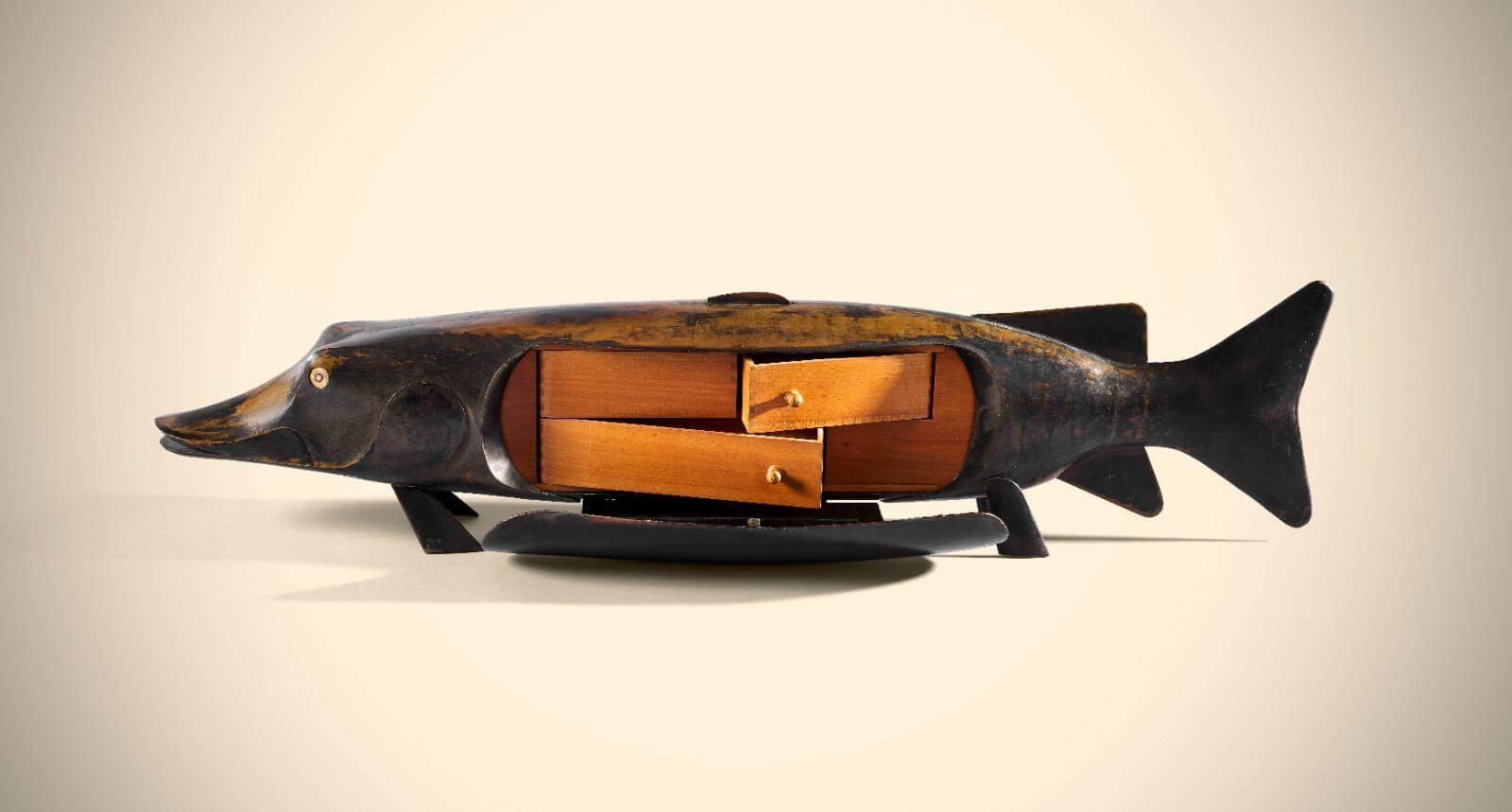
François-Xavier Lalanne, ‘Brochet’, c. 1973
COURTESY: Galerie Mathivet & PAD London
Artists turn to furniture
In the vein of Les Lalannes, an increasing cohort of artists are making functional work, perhaps as a way to transcend a capricious fine art market and reach a new collector. Among those with pieces at PAD is American artist Adam Pendleton, known for using ‘Black Dada’ as an open conceptual framework to explore the relationships between Blackness, abstraction, and the historical avant-garde. Just after a solo show of his paintings and drawings opens at the Stedelijk Museum Amsterdam, (Some Wild Kind of Language, 10th October 2026 – 17th January 2027), New York’s Friedman Benda gallery will bring a new onyx coffee table by Pendleton to PAD London, a minimalist antidote to the whimsical Lalanne piece. It is an extension of the collection at his solo show with the gallery in late 2025, titled Who Owns Goemtry Anyway?, in which seemingly simple geometric forms — circles, squares, triangles — become points of departure for complex material, visual, and theoretical explorations. Other artist-designed furniture to look out for at PAD includes an armchair by Diego Giacommetti at Galerie Jacques Lacoste and several works inspired by animals by contemporary artist Jean-Marie Fiori at Galerie Dumonteil.
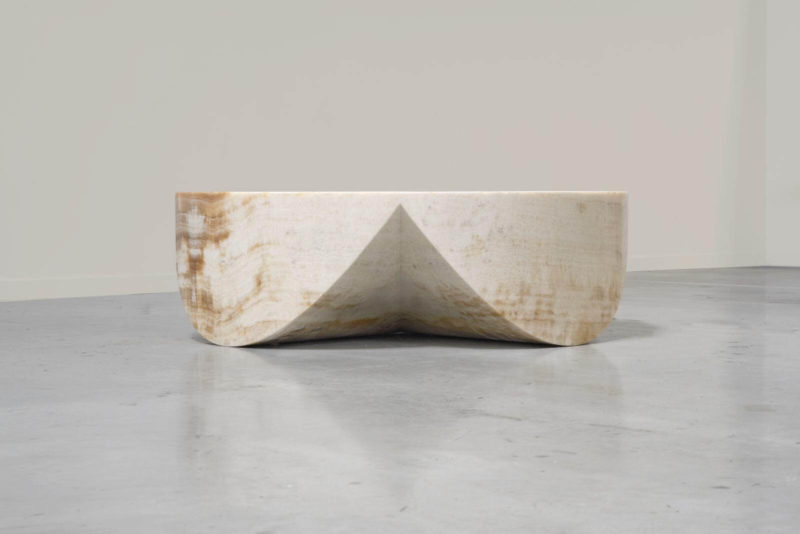
Adam Pendleton, ‘Poetics of Form Inverted’
COURTESY: Friedman Benda and Adam Pendleton / PHOTOGRAPH: Fabrice Gousse
The art of slumber
Today’s obsession with sculptural headboards, which proliferate across Instagram, can be traced back to the noughties when designers and craftspeople such as Gaetano Pesce and Salvino Marsura transformed the art of slumber. Pesce conceived a series of bed-cum-sculptures as part of his collaboration with Zerodisegno, born from an encounter between Pesce and founder Carlo Poggio in 2002. The pair shared a subversive streak, which resulted in collections that, “brought art into the factory and the Zerodisegno factory into museums,” as the company put it. The furniture celebrated imperfections, with components made from polyurethane-based elastic resins cast separately, making each piece chemically and visually distinct. Two faces are locked in a kiss on the headboard of the 2007 ‘Nobody’s Perfect’ bed – an edition of nine from the collection, ‘Il Rumore Del Tempo’ (The Noise of Time) – which will be presented by Pulp Galerie at PAD London. Its black, red and yellowish tones defy the calming sanctuary we are told we need for a good night’s kip. Who needs sleep anyway? Welcome to Frieze week!
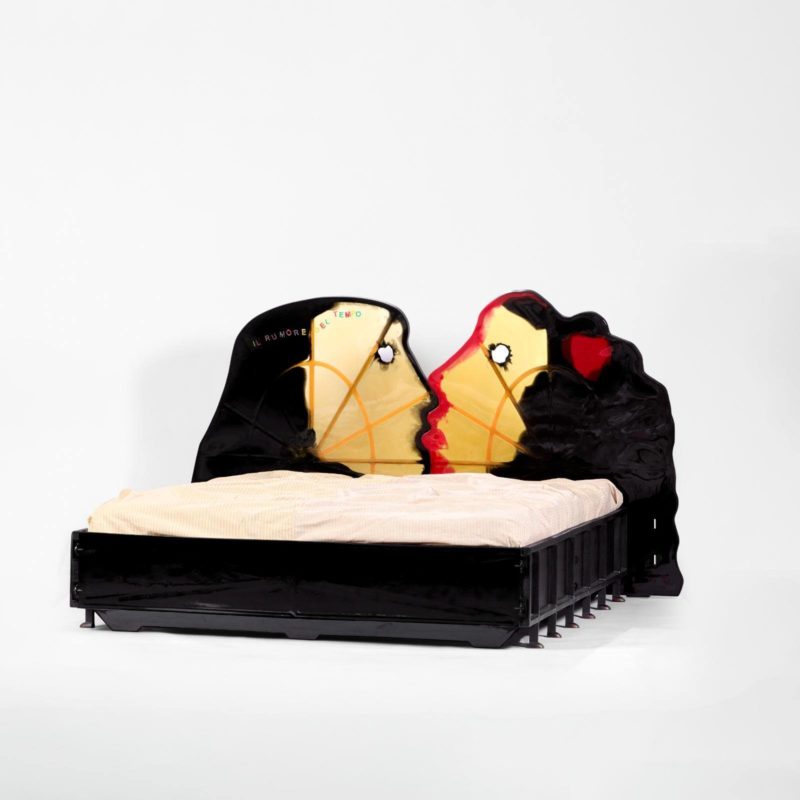
Gaetano Pesce, ‘Nobody’s Perfect Bed’, 2007
COURTESY: Pulp Galerie & PAD London / PHOTOGRAPH: Alexis Narodetzki