Preview / TEFAF Maastricht 2026
TDE focuses on the rich offerings of furniture designed by architects.
MECC, Maastricht
14th-19th March 2026
By Emma Crichton-Miller / 8th March 2026

Gerrit Th. Rietveld, ‘Aluminium Side/Table Chair’, designed 1951, made 1951-64
COURTESY: Galerie Van den Bruinhorst
The ground-breaking Dutch designer Gerrit Rietveld once wrote: “When we construct, all we do is take out from natural space a suitable amount of space, enclose and protect it, and the whole of architecture is born from this necessity.” At The European Fine Art Fair in Maastricht (TEFAF) – running from 11th– 19th March – you can find in the ‘Modern’ and ‘Focus’ section, a selection of pieces of furniture made by architects, which brilliantly and differently extend Rietveld’s notion into the realm of furniture design.

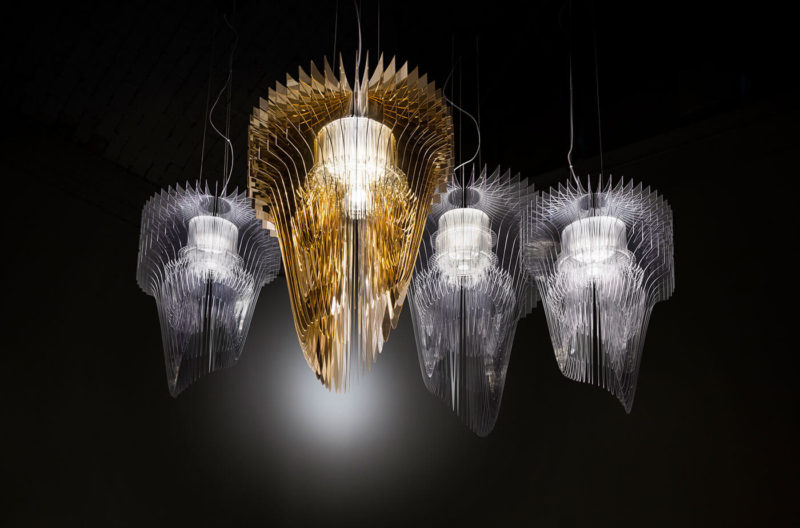
Formafantasma, ‘Chandelier’, 2024
COURTESY: Friedman Benda & Formafantasma / PHOTOGRAPH: Marco Cappelletti
GALERIE VAN DEN BRUINHORST
Specialists in radical modernist early twentieth-century art and design movements, the Van den Bruinhorst gallery is mounting a solo focus on Rietveld specifically for TEFAF entitled ‘Rietveld’s Visions’. It was a piece of furniture that marked the transformation of Gerrit Rietveld from a carpenter to an architect. An accomplished traditional furniture maker, Rietveld had joined his father’s furniture business aged eleven, whilst studying industrial art and design in the evenings. In 1917, inspired by his studies, he set up his own cabinet-making business, to experiment with a wholly new approach.

Gerrit Th. Rietveld, ‘Beach Buggy’, 1922-23
COURTESY: Galerie Van den Bruinhorst
In 1919 he produced his revolutionary slatted armchair. This bold exemplar of modern design principles – its economy of means and materials, the way in which there is perfect expression of function through form – was seized upon by the De Stijl art movement in Holland as an icon of modernity. For a while Rietveld was swept into their orbit, in 1923 repainting the chair red, blue, black and yellow, in keeping with the movement’s insistence on primary colours. From this creation, everything flowed. A year later, he built his first house, the renowned Rietveld Schröder House, with his patron and collaborator, Truus Schröder. From then, he pursued his own path, moving between the design of domestic spaces for all levels of society and the design of furniture that would reflect similar values: modesty of means but the most ambitious of outcomes. “I am constantly concerned,” he said, “with this extraordinary idea of the awakening of the consciousness.”
At TEFAF, the gallery is showing one of the best preserved examples of Rietveld’s early ‘Beach Buggy’ (1922–1923), composed of the same elements as his slatted armchair, with the essential addition of circles, for the wheels. It was used by the family who owned it until recently for its primary purpose – trips to the beach.

Gerrit Th. Rietveld, ‘Beach Buggy’, 1922-23
COURTESY: Galerie Van den Bruinhorst / PHOTOGRAPH: from the family archives
Also on view will be an example of Rietveld’s futuristic ‘Aluminium Side/Table Chair’ from 1951-64: made from a single sheet of aluminium, folded and bent, assembled using welding and blind rivets. A wrapping of space in metal.

Gerrit Th. Rietveld, ‘Aluminium Side/Table Chair’, designed 1951, made 1951-64
COURTESY: Galerie Van den Bruinhorst
GALLERIA ROSSELLA COLOMBARI
For her first outing at TEFAF, Rossella Colombari, based in Milan, has chosen, amongst other pieces, two star works by seminal architect designers Osvaldo Borsani (1911-1985) and Carlo Mollino (1905-1973). Both were seized with the same inspiration to create unique buildings and interiors to reflect both the mood of the times and the spirit of the individuals who dwelt there. As the Turin-based architect Mollino put it, a home is like a shell that “is formed over time in infinite layers that are the negative and petrified image of the animal living within: it is the practical expression of a feeling.” Most of his items of furniture are unique pieces designed for a specific interior and client, however Colombari is showing the experimental desk designed in 1954 for Casa Editrice Lattes, in a limited run.

Carlo Mollino, ‘Desk designed for Casa Editrice Lattes’, 1954
COURTESY: Galleria Rossella Colombari
Crafted from wood, with structural and decorative details in brass, and a surface of FibroSil, it marries formal logic with the poetry of almost animal movement, balancing structural solidity and visual lightness. It exemplifies the highly personal design language forged by the designer in the 1950s, in pursuit of his ambition as an authentic modern architect, “to escape to a new, hoped-for world that does not exist yet; one that is not simply a nostalgic reenactment of a lost condition.”

Carlo Mollino, ‘Desk designed for Casa Editrice Lattes’, 1954
COURTESY: Galleria Rossella Colombari
Alongside is an almost contemporaneous (1952) cabinet designed by Borsani for a private Genoese family. This represents an idiosyncratic integration of fine craftsmanship, using luxurious materials such as exotic hardwoods and black marble, with historical elements. The carved wooden panels on the front are of Chinese origin, dating to the second half of the 19th century, and decorated with gilding and polychrome motifs. The cabinet becomes a miniature museum, both displaying and constructed from its collection.

Osvaldo Borsani, ‘Living Room Cabinet’, 1952
COURTESY: Galleria Rossella Colombari
DAVID GILL GALLERY
The Iraqi-British architect Zaza Hadid was never limited in her ambitions for architecture and design. She once said, “I don’t think that architecture is only about shelter, is only about a very simple enclosure. It should be able to excite you, to calm you, to make you think.” David Gill Gallery, from London, is showing the designer’s gloriously sinuous ‘Double Seat Bench’, from her 2016 ‘UltraStellar’ series, her last for the gallery. Here, her fluid aesthetic is translated into organic walnut wood. The simple idea of an enclosure of space becomes emotional, an embrace, while the play of curves and spaces delights the mind.

Zaha Hadid, ‘Double Seat Bench “UltraStellar”’, 2016
COURTESY: David Gill Gallery
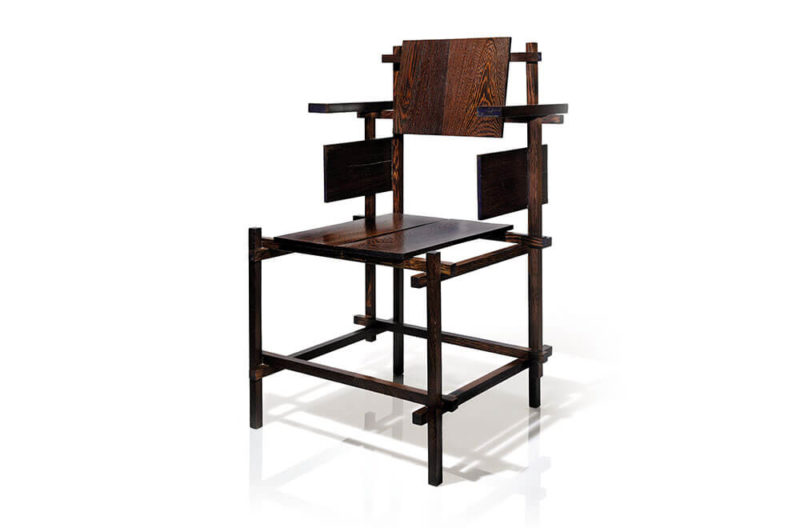
The German designer Valentin Loellmann, a specialist in wood, has over the last decade transformed two buildings in the Netherlands into living and work spaces where nature and the domestic cohabit. As well as moulding walls to his desire, he has filled both spaces with his own handcrafted cabinetry, furniture and staircase. On view in Maastricht are a desk and chair, in Loellmann’s characteristic fumed wood, their sinuous lines and sweeping forms belying the complexity of the workmanship.

Valentin Loellmann, ‘Desk and Chair’, 2025
COURTESY: David Gill Gallery
FRIEDMAN BENDA
Friedman Benda are bringing to Maastricht a solo presentation of the 2025 collection ‘Formation’ by the polymathic architect designers, Formafantasma. The Italian duo Andrea Trimarchi and Simone Farresin are a research-led design studio – initiating projects that develop around an idea.
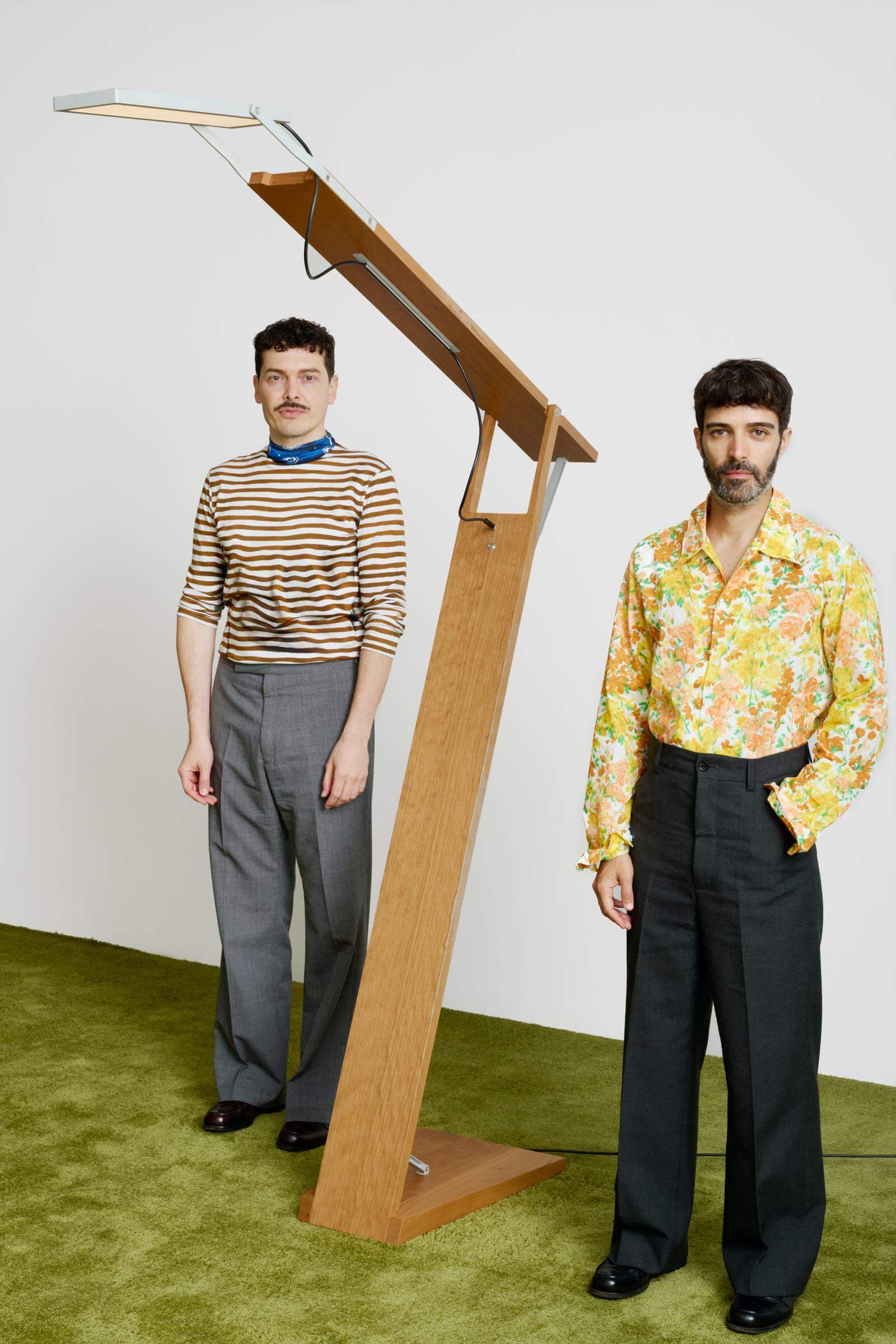
Formafantasma (Simone Farresin & Andrea Trimarchi)
COURTESY: Friedman Benda / PHOTOGRAPH: Izzy Leung
In these tables, lights and chairs, they pay homage to three distinct strands within American design history: the Shaker community, the master wood craftsman, George Nakashima, and the seminal modern architect, Frank Lloyd Wright. The cherry wood is a nod to the Shakers, whose approach, as the duo express it, “to utility and transcendence”, is reflected in this readily available material, the bedrock of the community’s pared back aesthetic.

Formafantasma, ‘Chair’, 2024
COURTESY: Friedman Benda & Formafantasma / PHOTOGRAPH: Marco Cappelletti
The brushed aluminium, ubiquitous in today’s digital devices, is married with warm wood, in a way that echoes Lloyd Wright’s fusion of craftsmanship and technology. Nakashima, meanwhile, was renowned for his reverence for timber as a living entity. Taking their cue from the idea of the plank – fundamental to all cabinet-making – while honouring the unique warm figuring of the wood, the pieces offer, instead of spectacle, an invitation to quiet reflection on the evolution of the everyday. The pieces effect a quiet intervention within space, in tune with a restrained architectural sensibility, but at home anywhere.
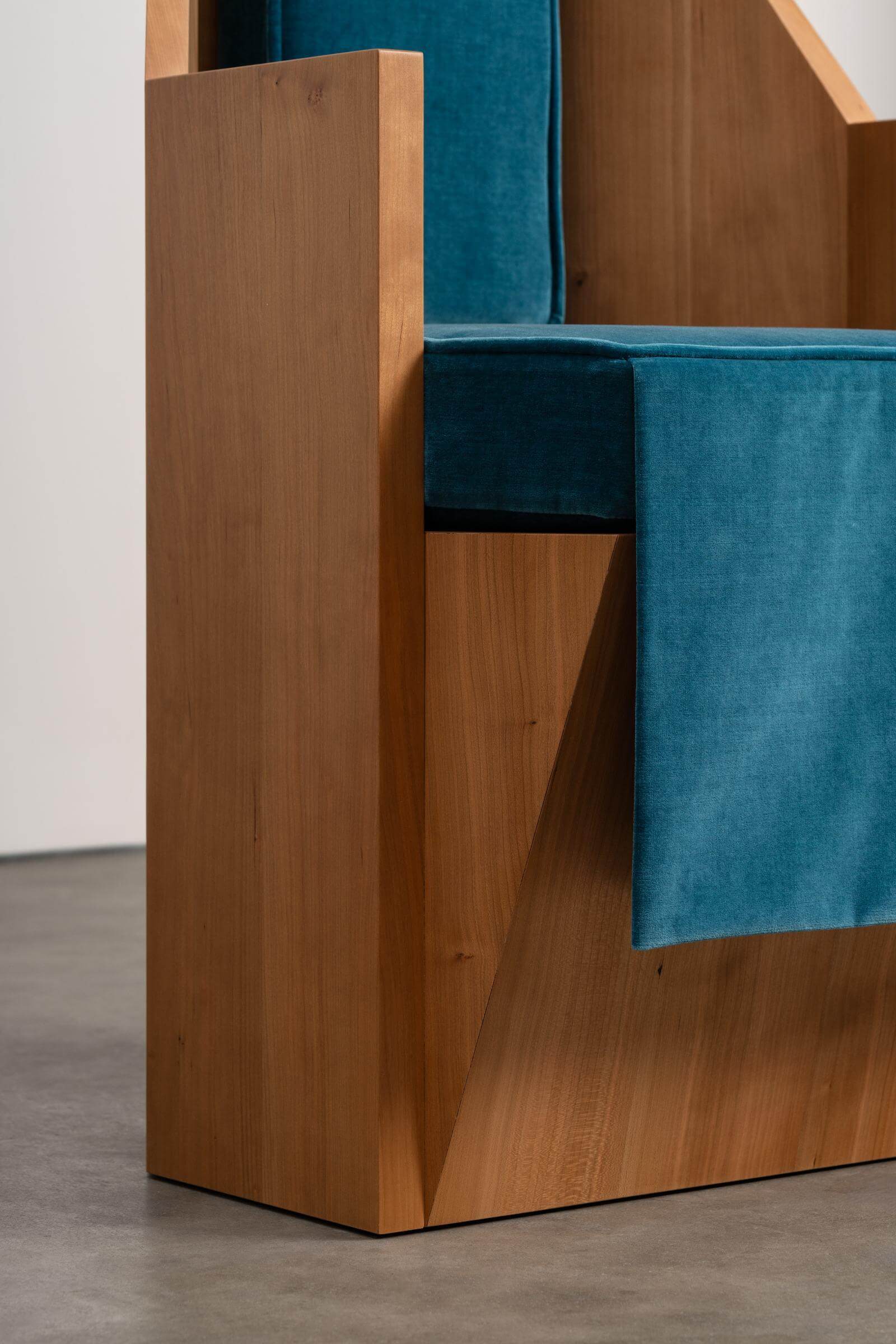
Formafantasma, ‘Chair’, 2024 (detail)
COURTESY: Friedman Benda & Formafantasma / PHOTOGRAPH: Marco Cappelletti
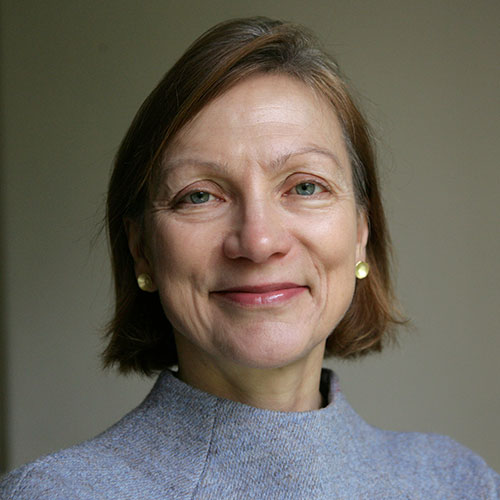
Emma Crichton-Miller is Editor-in-Chief of The Design Edit.
View all articles by Emma Crichton-Miller