‘I Tear Secrets From Your Yielding Flesh’, 2026
Nicola Turner
By TDE Editorial Team / 16th October 2026
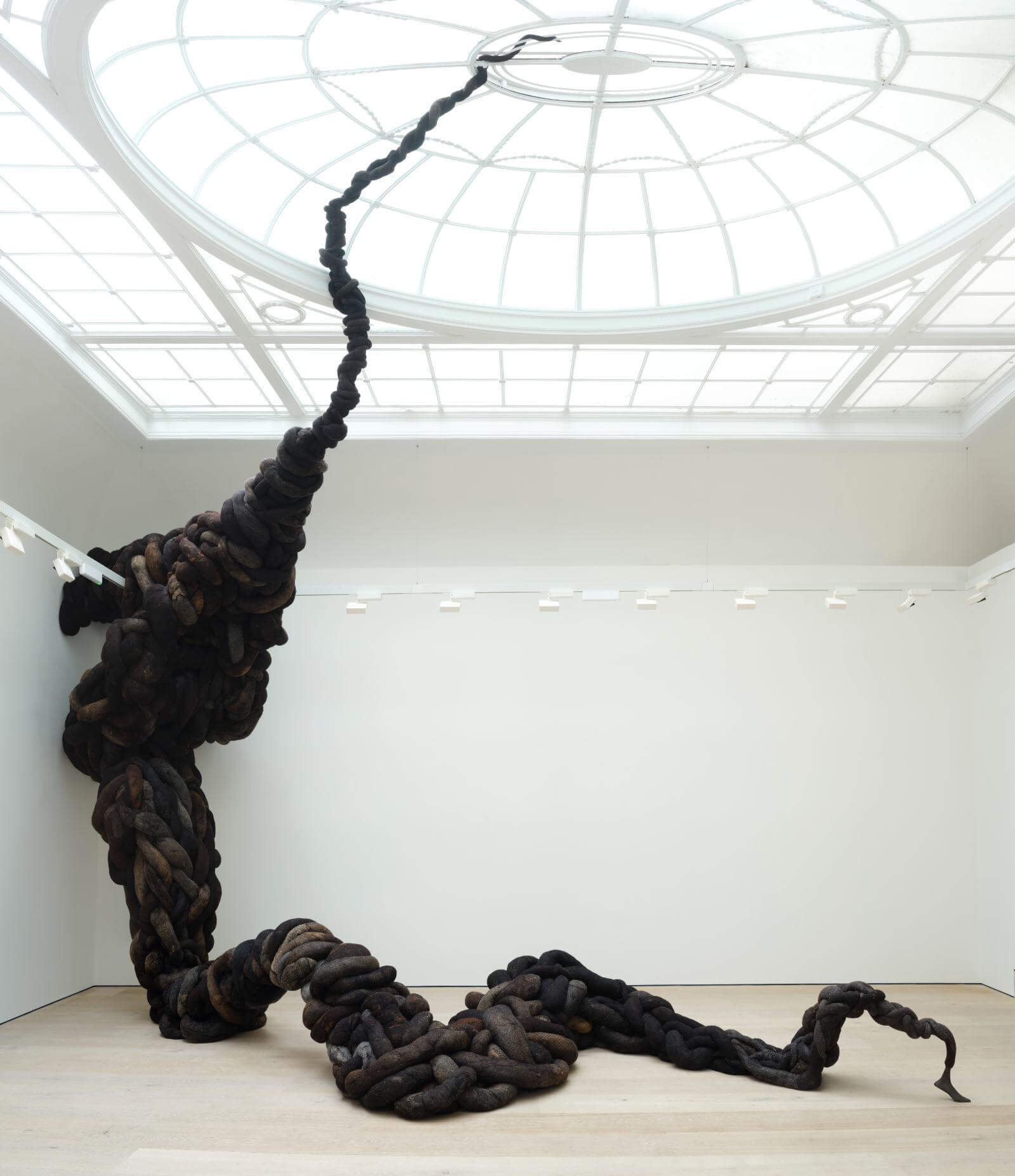
Nicola Turner, ‘I Tear Secrets From Your Yielding Flesh’, 2026
COURTESY: © The Artist & Annely Juda Fine Art
IN AN ELEGANT light-filled early Georgian reception room in Central London, it seems a monstrous creature has claimed its home. It is hard to tell if it is meant to be animal or vegetable. Its black tendrils twist and turn high into the skylight like a plant, as its muscular innards sprawl into the room. At its other terminus, on the floor, a delicately carved wooden shoe last, poised as if ready to dance, suggests the human world of high fashion, refined deportment and restrained manners, that once spun beneath the glass dome.
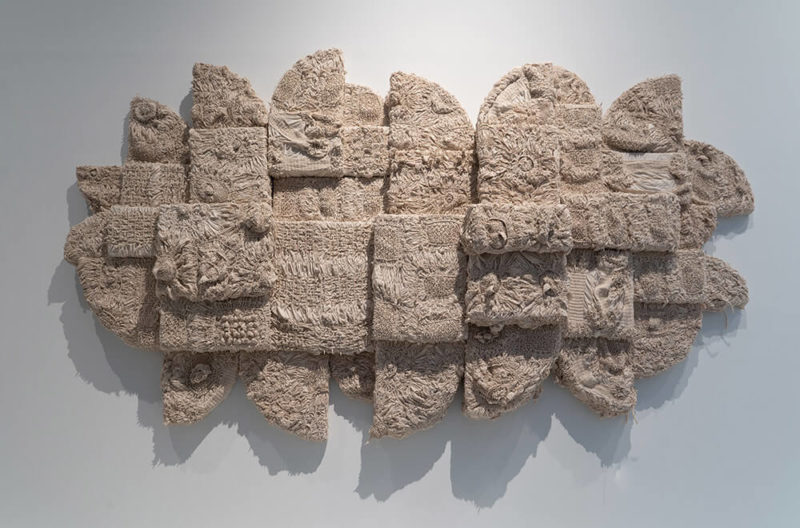
This magnificent new work by the artist Nicola Turner takes the stuff that normally lies hidden – the undyed horsehair from old mattresses, which sustain both life and death, the wool that clothes us beneath the silk – and gives it its own life. It is as if the house had been turned inside out. The secrets of its vanished furnishings bulge writhingly within rough hand-sewn mesh to signal the physical and emotional secrets once suppressed, but now rampant, within these empty rooms. Our imaginations participate in the exposure, exhilarated by the wild vigour of these once domesticated materials and the unleashed eroticism and calligraphic beauty of the artwork.
The work’s title is drawn from a line in Vita Sackville-West’s erotic poem to her secret lover Violet Trefusis, written in 1918 and only discovered in 2013. Sackville-West, who was later a lover of Virginia Woolf, had married Harold Nicolson in 1913, to honour a heterosexual convention neither followed. Her wedding dress was made by the elite London Couture house and dressmaker Reville & Rossiter, who had briefly made this building, 16 Hanover Square, and its neighbour, their headquarters. While here, they had won a Royal Warrant when, in 1910, they had dyed all their fabric stock black to provide mourning dress to fashionable society after the death of King Edward VII. The black of these mourning clothes chimes with an earlier episode in the building’s history, when it was the Royal College of Chemistry. Here, in 1856, a young chemist, William Henry Perkin, accidentally discovered the synthetic purple dye, Mauveine, while he was attempting to synthesise quinine. He patented the aniline dye, which went on to spark a fashion for purple clothing. These histories resonate in Turner’s own dark organic colours: grey, brown and black.
If site-specific associations such as these nourish Turner’s work, so too she draws on the example of artists such as Louise Bourgeois and Sarah Lucas. They have also worked with the potential of fabric, stitch, stuffing, materials, mesh and stocking to expose and express distinctly feminine experiences of loss, bereavement and pain. But as with those artists, there is wit and a resilient energy in the work as it rises from the personal, twisting into its tail whole eras of being and feeling suggested by the house and its spectacular architecture.
Nicola Turner: ‘I Tear Secrets From Your Yielding Flesh’
Annely Juda Fine Art
1st October – 7th November 2026
16 Hanover Square, London W1S 1HT