LDF / Woo Jin Joo: Bodily Inbetweenness
"The idea of transformation is really important in my work; that nothing is constant, that we’re always in a state of change.”
Bodily Inbetweenness
Ruup & Form, London
11th September – 13th November 2026
By TDE Editorial Team / 12th August 2026

Woo Jin Joo, ‘Dokkaebi Feet 1’, 2024
COURTESY: © The Artist & Ruup & Form
WOO JIN JOO, born in South Korea and now based in London, is a new talent already attracting significant institutional interest. In 2023, she was the inaugural winner of the Bagri Craft Award at Cockpit, offering three years of subsidised studio space and mentorship at the south London incubator. It was two years earlier, however, as she graduated with an MA in Textiles, Mixed Media from the Royal College of Art (RCA), that she first drew attention, winning the Janome Fine Art Textiles Award during the 2021 Festival of Quilts, for ‘When a Tiger Dies, It Leaves Behind Its Skin. When a Man Dies, He Leaves Behind His Name.’ This magnificent conjuring of a tiger through freehand embroidery on an IKEA shopping bag, titled after a Korean proverb, epitomises the imaginative vitality of Joo’s practice.

Woo Jin Joo, ‘Ardour’, 2026 (detail)
COURTESY: © The Artist & Ruup & Form / PHOTOGRAPH: Robert Chadwick
Since then, Joo has continued to develop the sculptural potential of embroidery, using a Juki embroidery machine, alongside painting, knitting, ceramics, animation and a variety of found objects to create two- and three-dimensional works. Many are inspired by Korean folklore, and Asian mythologies and philosophies. The works emerge from complicated technical processes but express an energy and humour that suggests they sprang to life, fully formed, emerging from the subconscious into the material world through their own volition.

Woo Jin Joo, ‘Tireless’, 2024
COURTESY: © The Artist & Ruup & Form
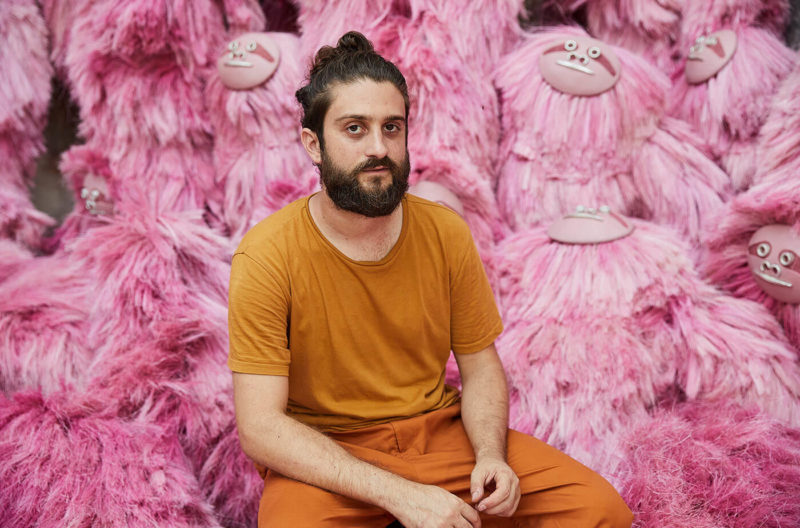
The new show, ‘Bodily Inbetweenness’, is Joo’s first solo show with Ruup & Form, and offers an immersive encounter with her imaginative universe. It forms part of the London Design Festival (LDF). The Design Edit went to meet the artist in her Deptford studio.

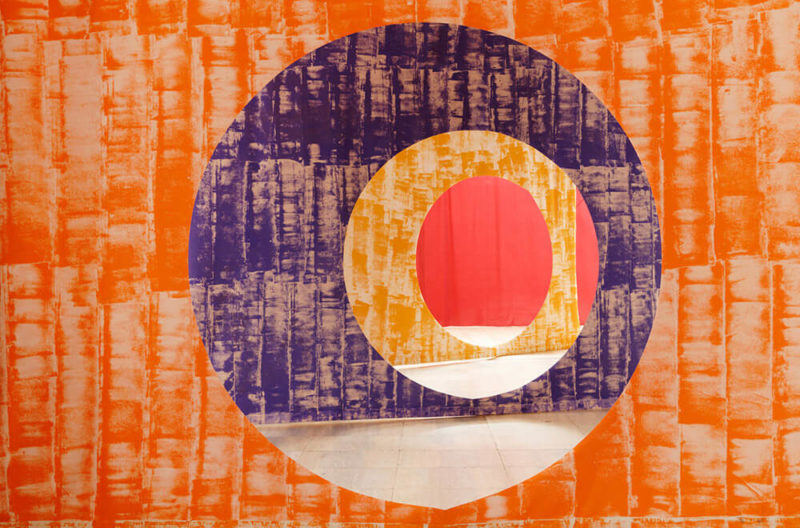
Exhibition view, ‘Bodily Inbetweenness’
COURTESY: © The Artist & Ruup & Form
TDE: Tell me a little about your childhood?
WJJ: I was born in Korea, to Korean and Chinese parents, but moved to China when I was still in primary school. My maternal grandma, who is Korean, came with us. She raised my siblings and me, because my parents were working, and she really had an impact on the stories I know and the way I see the world. The more I have worked, the more I realise that these myths and folklore, and the act of storytelling, is what I am really interested in.

Woo Jin Joo, ‘Water Deities Series, The Urchin Man’, 2023
COURTESY: © The Artist & Ruup & Form
TDE: You did a BA in Textiles at Central Saint Martins, specialising in print. Why did you make that choice?
WJJ: I love the drawing aspect, and I think that’s still strong in my practice. I also love screen printing, the activity of using your whole body. I was also interested in fashion and I debated between fashion and textiles – but with textiles, there was something about manipulating materials that I preferred.

Woo Jin Joo, ‘Formation Study I’, 2025
COURTESY: © The Artist & Ruup & Form / PHOTOGRAPH: Robert Chadwick
TDE: When did you encounter embroidery?
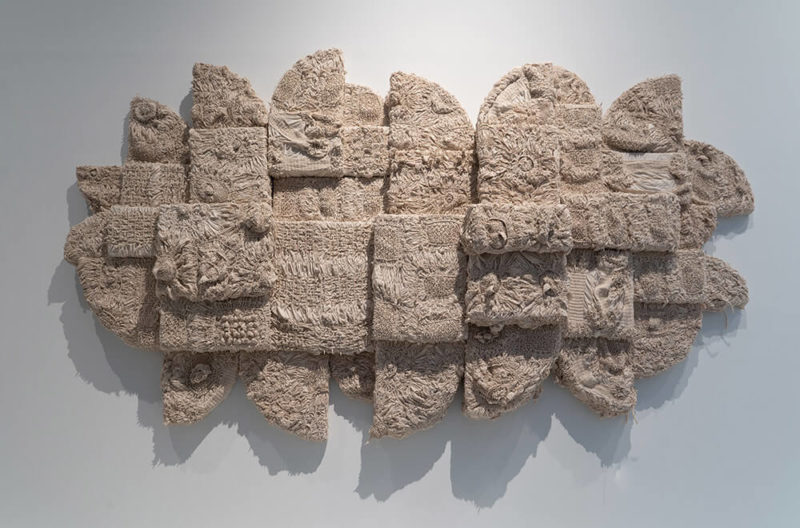
WJJ: At the end of my BA I began exploring material narratives – using plastics and found plastic bits to make jewellery. But at the RCA I discovered freehand embroidery, using a machine, and I loved it and felt immediately that it was three-dimensional for me. It never felt that this was a material that sits flat on the surface. I work with a dissolvable backing, which I embroider, and when you wash it you are left just with the thread. I love it when the thread is something of its own rather than dependent on the surface and I love creating sculptures with it. Depending upon how densely or sparsely you stitch, or even the way you wash it or brush it, you get different qualities or textures. Even with the most basic running stitch, you can use the thread in a way that is so alive and tactile.

Woo Jin Joo, ‘The Hairy Frogfish’, 2025 (detail)
COURTESY: © The Artist & Ruup & Form / PHOTOGRAPH: Robert Chadwick
TDE: How did you develop the story-telling side of your practice?
WJJ: I began experimenting with this technique and then the element of culture and heritage started coming in. I began to remember stories from my childhood. One of the biggest inspirations is the idea of Dokkaebi from Korean folklore, the idea of inanimate objects becoming spirit beings which could, if you treat them well, bring you good luck and good fortune – but if you mistreat them, they could also do harm and trick you. Then there are other stories and symbols that I thought it would be interesting to combine. The storytelling is very bound up with thread. After I graduated I began to use found objects – a coat in a charity shop, a glove I found – and through embroidery I could conjure the spirit of it, climbing out of it. I love the idea of forgotten or unwanted things, the overlooked, and making my own works up out of these rediscovered things. It’s an accidental encounter, but meaning comes out of it.

Woo Jin Joo, ‘I Hear Things Existing With Me’, 2026
COURTESY: © The Artist & Ruup & Form / PHOTOGRAPH: Robert Chadwick
TDE: You have expanded your work in several directions – creating wall-based pieces inspired by the idea of water deities, building large-scale sculptures of creatures or body parts and collaborating with a ceramicist to create hybrid objects. What unites these artworks? And are the creatures you depict traditional figures, or your own imaginings?
WJJ: I think they are very much my own invention. The idea of transformation is also really important for my work, the idea that nothing is constant, that we’re always in a state of change, an idea expressed in traditional myth or philosophies like Daoism. Who I am inside mixes with the world I experience outside, nothing is static. But something about these limbs, body parts and mythical creatures is also innately fun and playful. I want to communicate these different perspectives and stories in a way that’s engaging.

Woo Jin Joo, ‘I Hear Things Existing With Me’, 2026 (detail)
COURTESY: © The Artist & Ruup & Form / PHOTOGRAPH: Robert Chadwick
TDE: What is the premise for ‘Bodily Inbetweenness’ at Ruup & Form?
WJJ: We are creating an entire environment to convey that idea of things coming either up from the subconscious, or out from behind walls; becoming physical in the physical space, the things that we try to push to the back of our mind, or behind closed walls. I feel that these creatures might live in everyone’s imagination but are held back by day-to-day life. I want to bring back enchantment and magic to our shared space.