Wendell Castle: Living
A new exhibition that shows craft moving beyond material virtue into atmosphere, fantasy, and authorship.
Friedman Benda, New York, NY
17th September – 17th October 2026
By Adrian Madlener / 12th August 2026

Exhibition view, ‘Wendell Castle: Living’
COURTESY: © Friedman Benda & Wendell Castle Inc. / PHOTOGRAPH: Izzy Leung
ON THREE SPREADS of the magazine House Beautiful’s June 1973 issue, the upstate New York home of seminal American designer Wendell Castle and his wife, renowned ceramicist Nancy Jurs, came into full, colourful view. The feature and the experimental residence it presented is the subject of a new retrospective curated by their daughter – photographic book editor and historian, Alison Castle. The exhibition, which opens next week, will offer an imaginative reconstitution of their domestic space, one in which the prominent late 20th-century artists unabashedly lived with their own multidisciplinary output, alongside those from equally era-defining contemporaries.

Original spread from House Beautiful magazine, 1973
COURTESY: Friedman Benda & Wendell Castle Inc.
As detailed by the then House Beautiful art/craft editor Anne Ogden, the mill Wendell Castle gutted and renovated with his own hands was a multi-level, live/work environment unconfined by walls, where Castle’s now iconic laminated plastic ‘Molar’ chairs played well with Jurs’ “whimsical vacuum cleaner sculpture.” Defined by an array of organic shapes, various seating area vignettes were arranged according to mood. Everything down to the dinnerware and cutlery was considered.

Original spread from House Beautiful magazine, 1973
COURTESY: Friedman Benda & Wendell Castle Inc.
“They didn’t set out to furnish their home piece by piece,” Alison Castle reflects. “I’d venture to say that a minority of the pieces were actually purpose-made for the space – a jewellery box for my mother, a square table to play cards on, plates and mugs, comfortable sofas – those are the sort of things that they would have made expressly for their home.”

Exhibition view, ‘Wendell Castle: Living’ featuring ‘Molar’ chairs
COURTESY: © Friedman Benda & Wendell Castle Inc. / PHOTOGRAPH: Izzy Leung
The article also highlights how the home, located in Scottsville, New York (just outside Rochester), included pieces that “hinted at what was to come.” “The reality was, since they were trying to make livings for themselves, a lot of the pieces that ended up in their living space were either unsold, or not yet sold,” Alison Castle adds. “Once a piece was finished downstairs and it didn’t have anywhere to go yet, it had to come upstairs as there wasn’t enough room to store it in the studio. Some of the pieces we held onto for years (or forever) while others left to their new homes relatively quickly. It was from spending quality time with them, observing these objects and using them, that my parents had a lot of time to continue assessing their own work and thinking about ideas for future pieces.”

Wendell Castle in his home, circa 1970s
COURTESY: © The Estate of Wendell Castle & Friedman Benda
Though Wendell Castle had already made his seismic debut with the sinuously subversive ‘Sculptural Stool’ in 1959, this article, published almost a decade and a half later, was a boon for his still-fledgling practice. (Jurs had her breakthrough moment in the 1980s with the unveiling of the butterfly- and female form-inspired ‘Wall Pouches’ series, a shift away from already nonconformist functional vessels – many of which filled the home – to a full, unapologetic artistic practice, untethered by any need to justify her aesthetic explorations.)
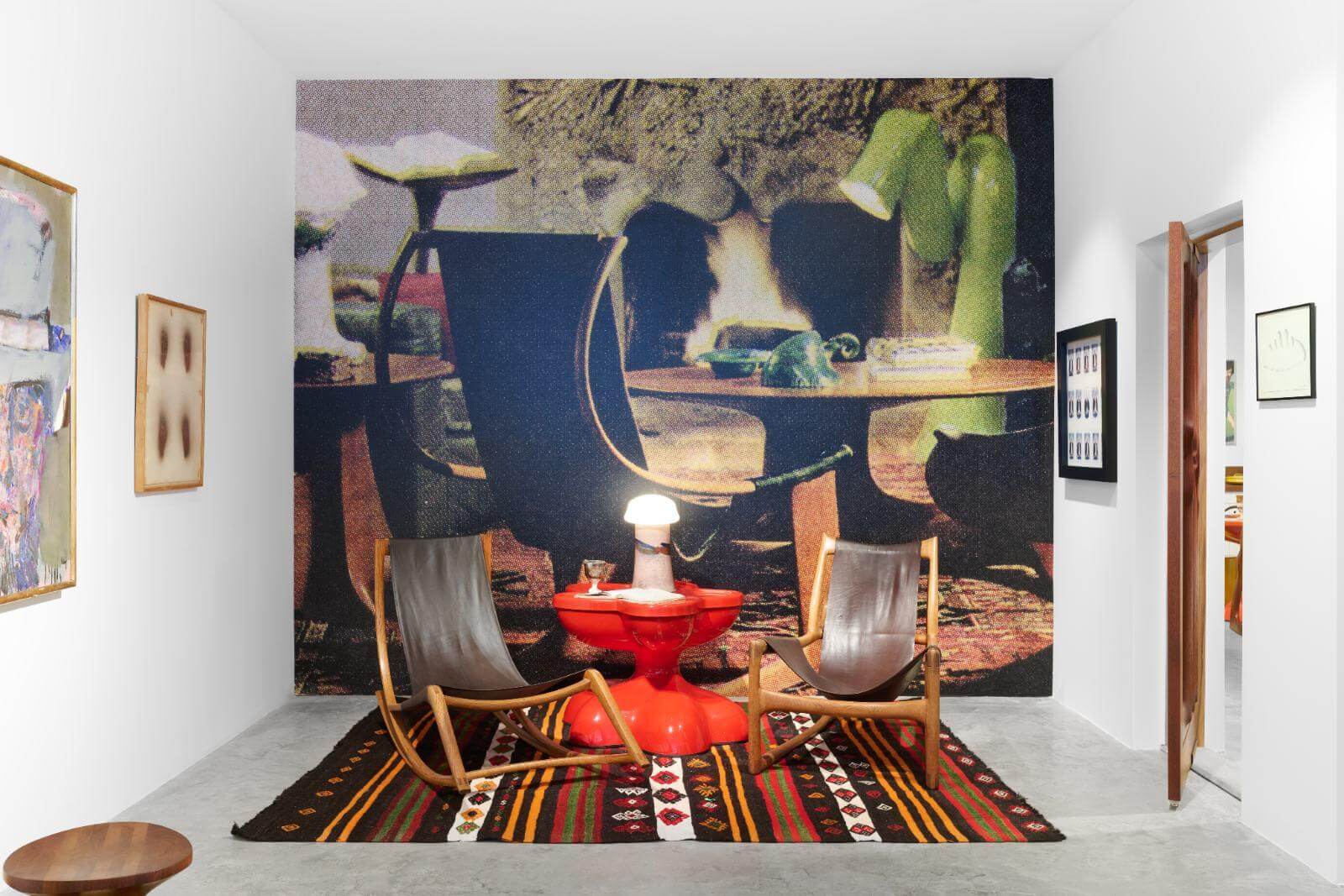
Exhibition view, ‘Wendell Castle: Living’
COURTESY: © Friedman Benda & Wendell Castle Inc. / PHOTOGRAPH: Izzy Leung
“What was especially purposeful in the space was the art by their friends that they purchased and traded for, and it’s these artworks that rounded out the home furnishings, bringing richness and depth to the interiors,” Alison Castle noted. There were pieces, lighting fixtures, even custom architectural features from many of the duo’s equally epochal contemporaries, such as paintings by Michael Venezia and a ceramic fireplace by Roy Cartwright.

Exhibition view, ‘Wendell Castle: Living’
COURTESY: © Friedman Benda & Wendell Castle Inc. / PHOTOGRAPH: Izzy Leung
Within the exhibition’s staged kitchen, flexible living/dining room space and bedroom, are pieces rarely seen other than in museum vitrines, like Castle’s 1962 ‘Chaise Rocker’ (fully visible in the article) and the particularly hard-to-categorise multifunctional ‘Environment’ from 1972. As if continuing the practice of rotating out pieces that eventually sold and replacing them with new ones, the show incorporates more recent pieces: ‘Caligari’s Mistress’s Desk and Chair’ (1990), ‘Arcadia’ (2010), and ‘Opposites Attract’ (2017). In that sense, this contextualised chronological exhibition comes together as a genuine retrospective, examining the full arc of Castle’s six-decade-long career. The constantly cultivated, never inert interior it recaptures could arguably be viewed as one of Castle and Jurs’ greatest, collectively created masterpieces. It was their very own castle, a lived-in tableau immune to the influence of beige or the chintzy boho-chic style that dominated the era.
Looking at the bigger picture, the feature was also inadvertently indicative of a shift in the American Studio Furniture Movement that Castle was so instrumental in shaping. “The article is clearly less like a showcase of ‘good craft’ and more like a lived-in manifesto for art furniture in the context of a mixed art-craft interior,” Alison Castle affirms. “The crossover is visible in the pieces themselves: the bright ‘Molar’ chairs, biomorphic tables, pod-like seating, weird lamps, irregular tables, clouds for shelves, and other domestic objects that behave like sculpture. They still work as furniture, but utility is no longer the visual argument. Function becomes the excuse for invention.”

Wendell Castle, 2013
COURTESY: Friedman Benda & Wendell Castle / PHOTOGRAPH: © Kevin Rowland
The feature marked a move away from the undeniably craft-led approach of modernist dictum – form following function – towards the freer notion of form reflecting individual authors’ expression, demonstrating the potential of rediscovered and newly formulated materials and techniques. For Castle in particular, it had been lamination of wood veneer, contour pre-shaping and subtractive carving of the resulting mass forms. In the years leading up to the House Beautiful feature, he successfully experimented with plastic and fibreglass. Later on, it was cast bronze, polychrome finishes and digital fabrication. Often, he mixed techniques to achieve the desired visual and visceral effect of his form-forward works.

Wendell Castle’s home, circa 1970s
COURTESY: © The Estate of Wendell Castle & Friedman Benda
“Our home became a total environment where furniture, ceramics, colour and architecture blur together. And I think the article reveals craft moving beyond material virtue into atmosphere, fantasy and authorship. So the article catches an important moment in the American Studio Craft Movement: from handmade functional objects toward sculptural, personality-driven design. If it anticipates Postmodernism, it’s through permission: permission for humour, oddity, theatrical colour, hybrid categories and forms that exceed rational explanation.”

Adrian Madlener is a Brussels-born, New York-based writer covering a wide range of design-related topics.
View all articles by Adrian Madlener